

Car Hire in Avignon — Gateway to the South of France
Avignon puts you at the centre of Provence, surrounded by lavender fields, vineyards and historic villages. This walled city, famous for the Popes' Palace and its half-bridge, makes an ideal base for exploring a region where Roman ruins, hilltop villages and wine routes unfold within an hour's drive. With your rental car, Avignon becomes the starting point for the southern France road trip of a lifetime.
Avignon's historic centre is surrounded by walls and best explored on foot. The Popes' Palace, Petit Palais museum and the famous Pont d'Avignon are all within walking distance. Park outside the walls — several public car parks sit conveniently near the centre. The A7 autoroute passes Avignon, connecting to Lyon northbound and Marseille southbound. The A9 heads west toward Nîmes, Montpellier and Spain. The city can be busy during the July theatre festival, so plan accordingly.
Provence-Alpes-Côte d'Azur
Plan this first.
Roman history, lavender fields, wine routes
Confirm before booking.
A7 + A9 autoroutes
Confirm before booking.
Avignon Provence Airport (AVN) — seasonal
Confirm before booking.
Match collection to the actual itinerary
Include transfers, parking days, opening hours and return timing when comparing the two options.
Hiring a Car at Avignon TGV Station
The TGV station sits outside the city walls, making it a practical collection point if you're arriving by train from Paris or Lyon. Rental desks are typically supplier-arranged or nearby. From here, you're immediately on the road to Provence's villages and vineyards without navigating the old town's narrow streets first.
Picking Up in Avignon City Centre
City centre collection places you inside the walls, close to hotels and restaurants. Parking garages are available, though spaces fill during peak season and festival time. Ask your supplier about drop-off flexibility if you're planning a one-way trip deeper into Provence or toward the coast.
Plan the handover, price and first drive
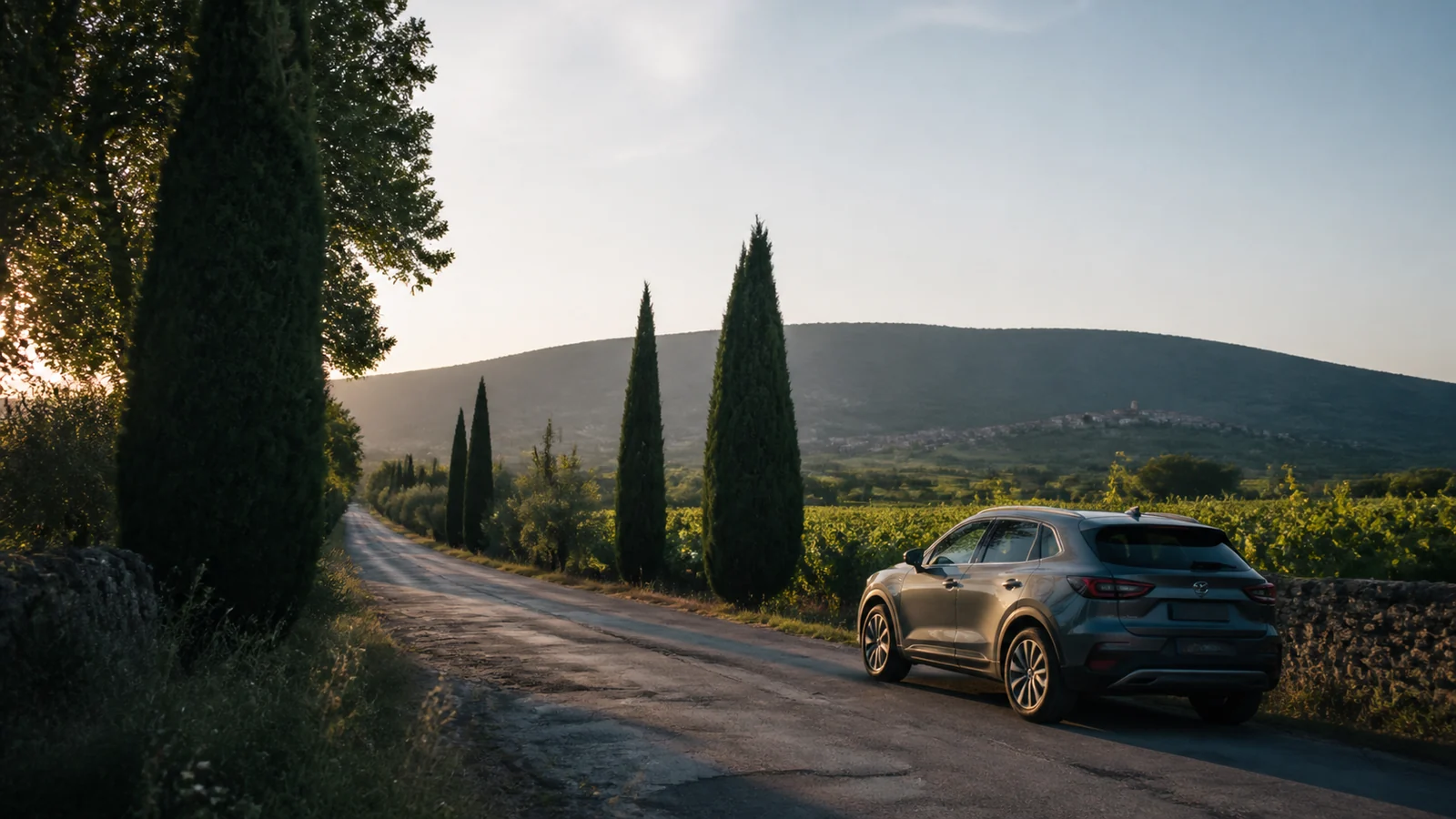
Provence has been seducing visitors since the Romans built their arenas and aqueducts here. But it's the light that keeps people coming back — that particular golden quality that made Van Gogh obsessive, that drew Cézanne to paint the same mountain dozens of times, that makes every village square look like a postcard at 6pm.
Avignon itself carries the weight of history without being weighed down by it. The Popes' Palace — the largest Gothic palace in Europe — dominates the skyline, but the city beneath it feels lived-in rather than museum-like. Students fill the cafés, locals shop at the market below the palace walls, and the famous bridge (the one in the song) ends abruptly in the river, as if the builder simply got bored.
With a car, the real Provence opens up. The Luberon villages aren't just pretty — they're working communities where farmers still tend the vineyards that produce Côtes du Rhône wines. In Roussillon, the ochre cliffs glow orange and red at sunset. In Gordes, the stone houses cascade down a hillside in a way that seems architecturally impossible.
Then there's the food. Markets in Provence are serious business — stall holders who've been selling the same cheeses and sausages for decades, truffles in winter, cherries in early summer, melons that smell like honey. With your hire car, you can fill a boot with provisions and picnic wherever the view takes you. That's the Provence most visitors never find — the one between the guidebook highlights, down a road that doesn't appear on your satnav.
Check the conditions behind the price
The selected supplier’s terms and booking voucher control the rental. Review them before payment and again before collection.
Total payable price
Compare the full payable amount and inclusions rather than an unsupported daily-price promise.
Deposit and payment card
Confirm the deposit, accepted card type and whose name must appear on the card.
Excess and cover
Read the renter's liability, exclusions and what any optional protection actually changes.
Fuel policy
Know the collection level, return requirement and whether a refuelling charge can apply.
Mileage and territory
Check any distance limit and where the vehicle may be driven.
Extras and return
Price additional drivers, seats, after-hours service and one-way return before payment.
Choose for people, bags and roads
A category normally represents a group of similar cars, not a promise of one exact model.
- Compact: convenient for couples and tighter parking.
- Intermediate: more room for bags and longer journeys.
- Family or SUV category: useful only when the required capacity justifies it.
- Transmission: select automatic explicitly if manual is unsuitable.
Practical planning before departure
Driving in Provence
Mountain roads in the Luberon are narrow and winding — take your time and expect slower progress than GPS estimates. The region is famous for its light, which attracted Van Gogh, Cézanne and Picasso.
Summer Traffic
The Riviera gets congested in July and August. Plan day trips for early morning departures, and allow extra time on coastal routes.
Parking in Avignon
Underground car parks near the centre are your best option. Street parking inside the walls is limited, and traffic restrictions apply in parts of the old town.
Fuel and Range
Petrol stations are plentiful along major routes. In remote Luberon villages, fill up before you set out for the day.
Local access, road and operating conditions can change. Check current signs, your supplier instructions and the linked source before travelling: Avignon Tourism.
Build a realistic first journey
The Popes' Palace and Avignon's Walls
Allow at least two hours for the palace tour. Walk the ramparts afterward for views across the Rhône to Villeneuve-lès-Avignon. The audio guide brings the papal history to life.
Les Baux-de-Provence and Saint-Rémy
This dramatic hilltop village perches on a rocky outcrop southeast of Avignon. The Carrières Lumières — former quarries hosting spectacular art projections — are unmissable. Nearby Saint-Rémy-de-Provence is where Van Gogh painted his Starry Night.
Pont du Gard — Roman Engineering Marvel
Forty minutes west, this is the best-preserved Roman aqueduct in the world. Walk across the lower tier, hike surrounding trails, or swim in the river below. Arrive early in summer.
Luberon Villages — Gordes, Roussillon, Bonnieux
Each village has its own character: Gordes clings to a hilltop with stunning views, while Roussillon is famous for its ochre cliffs. The winding roads between them are a drive in themselves.
Menton and the Italian Border
Forty-five minutes east marks the end of the French Riviera. Cross into Italy for lunch at Ventimiglia, where the Friday market is legendary among locals and travellers alike.
Frequently asked questions
Do I need a car in Avignon?
For exploring Provence properly, yes. While Avignon's centre is walkable, the Luberon villages, Roman sites and wine routes require a car. Public transport connects major towns but misses the scenic back roads.
What type of car is best for Provence?
A compact or mid-size car handles Luberon roads comfortably. Convertibles are popular in summer for the Mediterranean feel, though not essential.
Can I drive from Avignon to Nice in a day?
The A8 connects Avignon to Nice in around two hours, though summer traffic adds time. It's easily doable as a day trip, or break the journey with stops in Antibes or Cannes.
Is parking difficult in Avignon?
During the July festival, yes. Otherwise, the public car parks outside the walls are manageable. Avoid driving inside the historic centre — it's restricted and confusing.
Compare Avignon car hire
Enter dates above, then compare pickup method, vehicle category and complete supplier terms before booking.
Continue planning with Marseille Airport rentals, Nice Airport car hire, All 365 Car Hire locations, Paris Orly Airport Car Hire.