

Car Hire in France for Cities, Coasts and Regional Routes
Car hire in France is most useful when the itinerary extends beyond one well-connected city. Rail works well between many major centres, while a car becomes valuable for rural accommodation, coastal routes, small towns and journeys with several overnight bases. Use the all car hire locations page for the wider context, then compare the exact collection point, vehicle capacity and written terms for France.
Choose a car for regional travel, dispersed accommodation, early departures and routes where public transport would remove important stops. Do not assume it is necessary for central Paris, Lyon or Marseille. Collecting after the city stay can reduce parking costs, traffic and unused rental days.
Regional touring, coastlines, chateaux routes and multi-stop itineraries
Plan this first.
Paris airports, Lyon, Marseille, Nice, Bordeaux and city branches
Confirm before booking.
Environmental-zone rules, toll coverage and accommodation parking
Confirm before booking.
Some historic-centre hotels have no supplier-arranged parking; confirm before arrival
Confirm before booking.
Match collection to the actual itinerary
Include transfers, parking days, opening hours and return timing when comparing the two options.
Airport or City Office Collection
Compare the arrival airport with a city office. An airport collection suits an immediate onward drive; a central branch can suit travellers completing the urban part of the trip first. Save the full address, opening hours, supplier contact number and delayed-arrival procedure. The lead driver should bring the licence, identification, booking confirmation and accepted payment card required by the selected offer.
How to Compare Offers
Compare the same dates, driver age and return point across offers. A lower headline price is not better when the deposit, mileage, fuel terms or required extras do not suit the trip.
Plan the handover, price and first drive
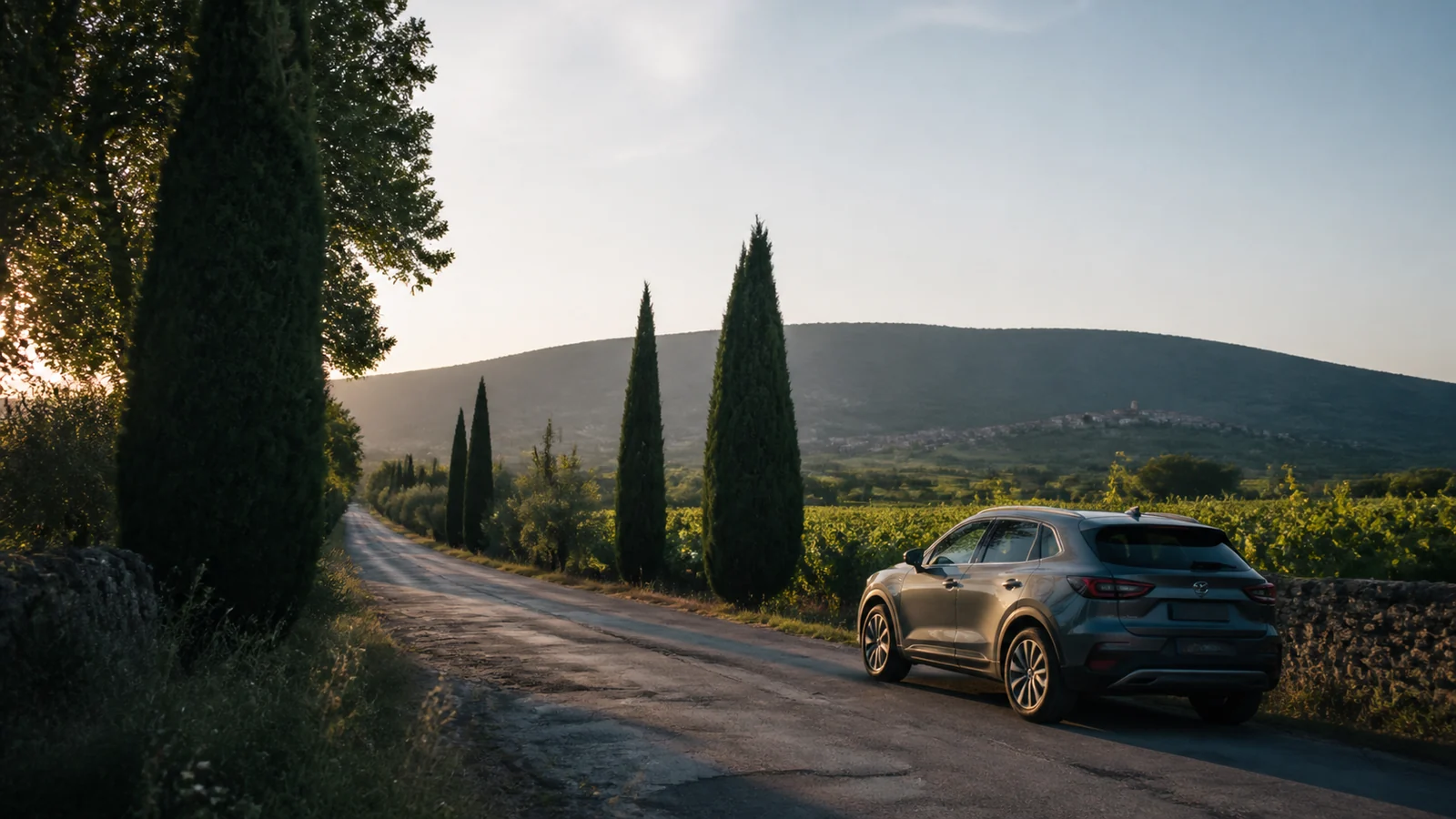
France rewards the driver who plans the route before picking up the keys. Between the vineyards of Bordeaux, the lavender fields near Marseille and the alpine roads outside Lyon, a well-chosen rental car turns scattered destinations into a single journey.
The mistake many travellers make is collecting the vehicle too early. If the first nights are in Paris, the car sits unused while parking charges accumulate. Better to enjoy the city by train and metro, then collect the car when the regional part of the trip begins.
Coastal routes along the south and west bring their own rhythms. Traffic moves slower in summer, parking fills early in resort towns and fuel stations can be sparse on rural stretches. Allow extra time for traffic and build flexibility into each day's plan.
Before confirming the booking, check the environmental-zone requirements, confirm hotel parking and read the fuel and mileage terms. The voucher controls the handover, so bring the required documents and payment card to the collection point exactly as stated.
Check the conditions behind the price
The selected supplier’s terms and booking voucher control the rental. Review them before payment and again before collection.
Total payable price
Compare the full payable amount and inclusions rather than an unsupported daily-price promise.
Deposit and payment card
Confirm the deposit, accepted card type and whose name must appear on the card.
Excess and cover
Read the renter's liability, exclusions and what any optional protection actually changes.
Fuel policy
Know the collection level, return requirement and whether a refuelling charge can apply.
Mileage and territory
Check any distance limit and where the vehicle may be driven.
Extras and return
Price additional drivers, seats, after-hours service and one-way return before payment.
Choose for people, bags and roads
A category normally represents a group of similar cars, not a promise of one exact model.
- Compact: convenient for couples and tighter parking.
- Intermediate: more room for bags and longer journeys.
- Family or SUV category: useful only when the required capacity justifies it.
- Transmission: select automatic explicitly if manual is unsuitable.
Practical planning before departure
Driving and Parking around France
Traffic keeps to the right. France has autoroutes, toll sections, environmental zones and local parking controls, so follow current official signs and check the rules for the exact route and vehicle. Confirm accommodation parking before arrival, especially in historic centres. A smaller car is easier to place, but it still needs enough room for every passenger and bag.
One-Way and Cross-Border Considerations
If the plan includes returning the car in another country or dropping it in a different French city, check the supplier's one-way policy and any cross-border fees. Not all permits cover every destination, and the voucher terms override general descriptions.
Local access, road and operating conditions can change. Check current signs, your supplier instructions and the linked source before travelling: France official tourism information.
Build a realistic first journey
Paris and Northern France
For a city-first itinerary, review car hire in Paris and collect only when the regional drive begins.
Lyon and the Alps Approaches
For eastern and south-eastern routes, compare Lyon car hire with the train and onward-road stages.
Marseille and Provence
For Provence and the Mediterranean coast, use the Marseille car hire page to set the practical endpoint.
Nice and the Cote d'Azur
For south-eastern coastal routes, see Nice car hire and plan stops between the city and the Italian border.
Frequently asked questions
Do I need a car in central Paris?
Trains and the metro cover central Paris well. A car is generally more useful for the regions outside the city or for collecting after the urban part of the trip.
What should I know about French toll roads?
Autoroutes often use toll sections. Check whether your rental includes a toll tag or whether you will pay at booths. Keep change or a card ready and follow current signage.
Are there environmental zones in France?
Some cities require clean-air stickers or have restricted zones. Verify the rules for your exact route and vehicle before departure.
Is airport pickup better than a city branch?
Airport collection suits an immediate onward drive. A city branch can suit travellers who want to finish the urban stay first and avoid city-centre parking and traffic.
Compare France car hire
Enter dates above, then compare pickup method, vehicle category and complete supplier terms before booking.
Continue planning with Paris car hire, Lyon car hire, Marseille car hire, Le Mans Car Hire.