

Car Hire in Mulhouse — Gateway to Alsace and Beyond
Mulhouse sits in the south of Alsace, minutes from Germany and Switzerland, at one of the most international corners of France. The city is known for its remarkable museums — the world's largest car collection and an equally impressive railway museum — but for travellers with a rental car the real attraction is what lies outside. The Alsace wine route begins just north of here, the Vosges mountains rise to the west, and the Black Forest begins across the Rhine. Basel in Switzerland is half an hour away. Whether you are here for wine, mountains, cross-border exploration or simply the pleasure of driving through some of France's prettiest villages, Mulhouse is an ideal starting point.
Mulhouse centre is compact and walkable, with the Place de la Réunion at its heart. Street parking is metered, and there are free car parks at the tram termini on the edge of town. The A35 and A36 autoroutes connect Mulhouse to Strasbourg, Basel and the rest of France, while the smaller D roads lead into the Vosges and the wine villages. The city is perfectly positioned for cross-border trips. Germany's Black Forest is twenty minutes east. Switzerland's Basel is thirty minutes south. The Alsace wine route runs north through Eguisheim, Riquewihr and Ribeauvillé. You are at the junction of three countries, three languages and three very different landscapes.
Grand Est
Plan this first.
Haut-Rhin
Confirm before booking.
Wine route, cross-border trips, museums
Confirm before booking.
Alsace Wine Route D5/D11
Confirm before booking.
Match collection to the actual itinerary
Include transfers, parking days, opening hours and return timing when comparing the two options.
City-centre pickup
Collecting your rental car in central Mulhouse puts you within minutes of the autoroutes and the wine route. The A35 north to Strasbourg and the A36 east towards Germany are both easily reached. The tram termini have parking if you prefer to leave the car and explore the centre on foot. Ask your supplier about one-way rentals if you are finishing in Strasbourg, Basel or another city.
Alsace and three-country exploration
A car from Mulhouse unlocks the entire Upper Rhine region. You can drive the Alsace wine route north to Colmar and Riquewihr, cross to Freiburg in Germany's Black Forest, visit Basel in Switzerland for museums and the Rhine, or head west into the Vosges for hiking and quieter roads. The distances are short, the borders are open, and the variety is remarkable. One day you are in a French wine village, the next in a German spa town or a Swiss art gallery.
Plan the handover, price and first drive
Mulhouse is not beautiful in the way that Colmar or Strasbourg are beautiful. It is an industrial city, built on textiles and engineering, with a functional grid of streets and a reputation for pragmatism. But it has something those prettier cities lack — position.
From Mulhouse you can be in Germany in twenty minutes, Switzerland in thirty, and the heart of the Alsace wine route in fifteen. The city is a crossroads in the most literal sense, and that makes it invaluable for anyone who wants to explore this corner of Europe without changing hotels every night.
The museums are genuinely world-class. The car collection alone justifies a stop, and the railway museum is a delight even for those who thought they had no interest in trains. But most visitors use Mulhouse as a base, heading out each morning to a different country or landscape and returning in the evening to eat in one of the city's solid, unpretentious restaurants.
Alsace is France's most contested region, and that history is visible in the architecture, the food and the bilingual street signs. With a rental car you can trace that history from the French villages to the German forests to the Swiss cities, all within a day's easy driving. Mulhouse is where those journeys begin.
Check the conditions behind the price
The selected supplier’s terms and booking voucher control the rental. Review them before payment and again before collection.
Total payable price
Compare the full payable amount and inclusions rather than an unsupported daily-price promise.
Deposit and payment card
Confirm the deposit, accepted card type and whose name must appear on the card.
Excess and cover
Read the renter's liability, exclusions and what any optional protection actually changes.
Fuel policy
Know the collection level, return requirement and whether a refuelling charge can apply.
Mileage and territory
Check any distance limit and where the vehicle may be driven.
Extras and return
Price additional drivers, seats, after-hours service and one-way return before payment.
Choose for people, bags and roads
A category normally represents a group of similar cars, not a promise of one exact model.
- Compact: convenient for couples and tighter parking.
- Intermediate: more room for bags and longer journeys.
- Family or SUV category: useful only when the required capacity justifies it.
- Transmission: select automatic explicitly if manual is unsuitable.
Practical planning before departure
Crossing into Germany and Switzerland
The borders are open within the Schengen zone, so there are no passport checks. Your rental agreement should confirm coverage for Germany and Switzerland — most standard French rentals include this, but verify before crossing. Switzerland requires a motorway vignette for use on autoroutes — available at petrol stations near the border for around forty Swiss francs. If you want to avoid this, stick to Swiss non-motorway roads. German autobahns have sections without speed limits, but drive carefully and stay in the right lane unless overtaking.
Parking in Mulhouse
The centre has metered street parking and several pay-and-display car parks. The tram termini on the outskirts offer free parking if you are comfortable combining driving with public transport for city exploration. In Alsace the wine villages have dedicated parking areas — often outside the old centres, which are pedestrianised. Arrive early in summer, as the most popular villages fill quickly with tourists.
The Alsace wine route
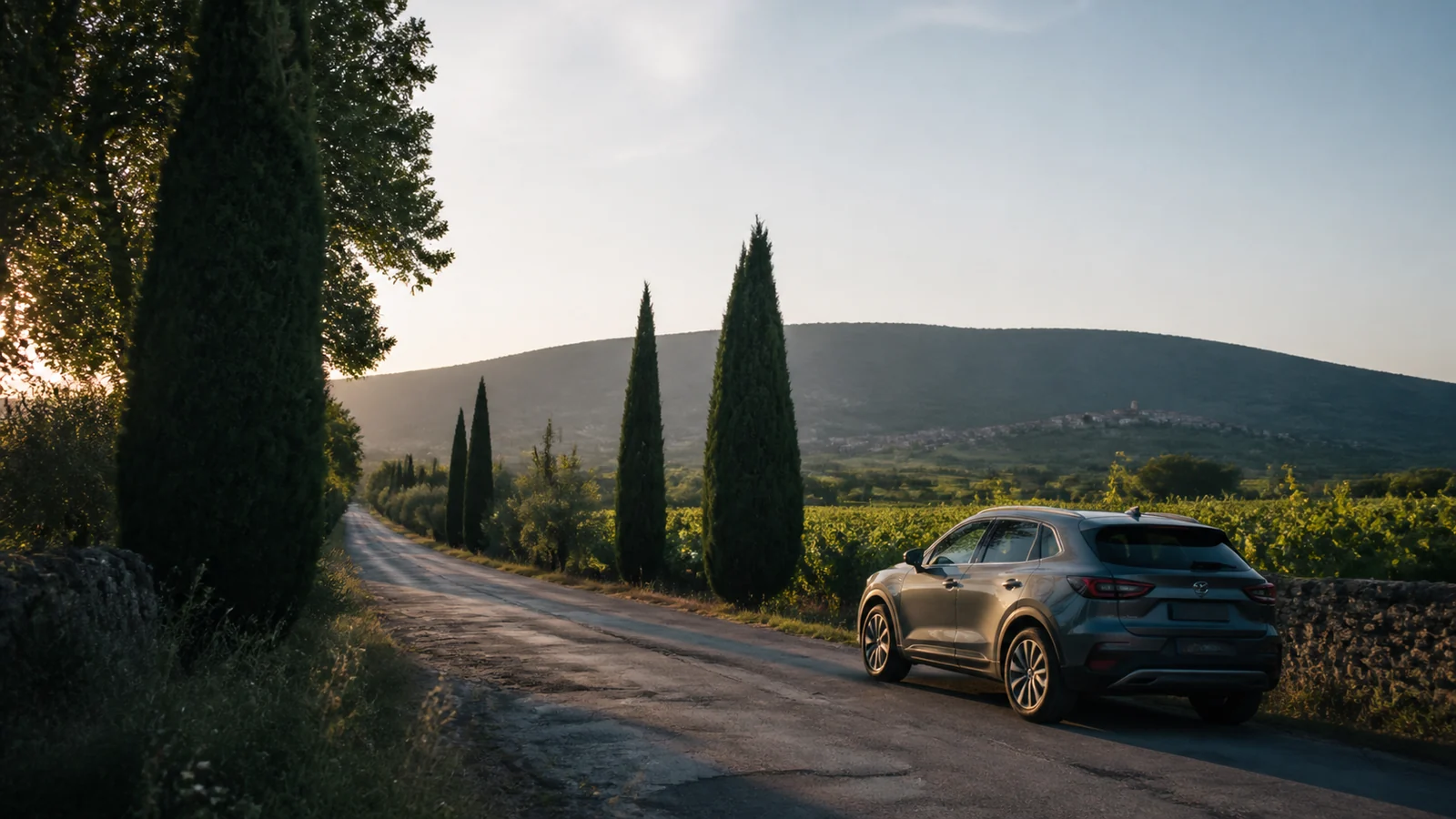
The Route des Vins d'Alsace runs north from Mulhouse through some of France's most photogenic villages. Eguisheim, Riquewihr, Ribeauvillé and Kaysersberg are the highlights, each with half-timbered houses, flower boxes and family-run wine cellars. The road follows the D5 and D11 — scenic but slow, with tight bends through villages. Allow a full day, stop for tastings, and designate a driver. Riesling, Gewürztraminer and Pinot Gris are the main varieties.
Local access, road and operating conditions can change. Check current signs, your supplier instructions and the linked source before travelling: Mulhouse Tourism.
Build a realistic first journey
Mulhouse to Eguisheim and Colmar
Head north on the D83 and wine route for about fifteen minutes to reach Eguisheim, a village of concentric alleys and colourful houses that is regularly voted one of France's most beautiful. Continue north for another twenty minutes to Colmar, the jewel of Alsace, with its canals, medieval streets and excellent restaurants. The drive is flat and easy, though the wine route roads are narrow and busy in summer. Park outside the old centres and walk.
Mulhouse to Basel
Drive south for roughly thirty minutes to reach Basel, Switzerland's cultural capital on the Rhine. The old town is walkable and full of museums, galleries and architecture. The Kunstmuseum is one of the best in Europe. Note that Swiss motorways require a vignette — buy one at the border or avoid motorways entirely. Basel is an easy day trip from Mulhouse, and the contrast between French and Swiss urban life is striking.
Mulhouse to the Black Forest
Cross the Rhine eastwards for about thirty minutes to enter Germany's Black Forest. The roads climb through pine forests and pass villages famous for cuckoo clocks, gateau and spa towns. Freiburg is the main city — young, green and lively, with a beautiful old town. Beyond Freiburg the forest becomes wilder, with hiking trails, waterfalls and lakes. The driving is straightforward, and the border crossing is seamless.
Frequently asked questions
Do I need a vignette for Switzerland?
Yes, if you plan to use Swiss motorways. The vignette costs around forty Swiss francs and is valid for a year. You can buy it at petrol stations near the border. If you are only visiting Basel and sticking to local roads, you do not need one. German and French motorways do not require vignettes.
Is the Alsace wine route easy to drive?
The main roads are fine, but the village sections of the wine route are narrow, winding and often crowded with tourists in summer. Drive slowly, expect pedestrians and cyclists, and use the designated parking areas rather than trying to drive into the old centres. The scenery is worth the patience — some of the most beautiful villages in France line this route.
Can I visit all three countries in one day from Mulhouse?
Technically yes, though it would be rushed. You could breakfast in France, drive to Basel for lunch, cross to Freiburg for the afternoon, and return to Mulhouse for dinner. A more relaxed approach is to dedicate a day to each country — one for the Alsace wine route, one for Basel and Switzerland, one for the Black Forest. The distances are short, so even a half-day trip is feasible.
What is Mulhouse famous for?
Mulhouse is famous for its industrial heritage and its museums. The Cité de l'Automobile is the world's largest car museum, with over five hundred vehicles including Bugattis and Ferraris. The Cité du Train is equally impressive for railway enthusiasts. Beyond the museums, the city is a practical, unpretentious base for exploring Alsace and the neighbouring countries.
Compare Mulhouse car hire
Enter dates above, then compare pickup method, vehicle category and complete supplier terms before booking.
Continue planning with Paris Orly Airport Car Hire, Le Mans Car Hire, Calais Car Hire, Lyon Airport Car Hire.