

Car Hire in Saint-Nazaire for Coastal and Countryside Road Trips
Saint-Nazaire sits at the mouth of the Loire estuary on France's Atlantic coast. Once a strategic shipbuilding port, the city is now a practical launchpad for exploring the Guérande peninsula, the beach resorts of La Baule, and the salt marshes that stretch along the shoreline. With a rental car you can move between port city, medieval towns, and long sandy beaches on the same day, making Saint-Nazaire a strong base for a western France itinerary.
Most suppliers have collection points around the city centre or near the main transport hubs. The exact meeting location, opening hours, and return procedure will be shown on your voucher after booking. Saint-Nazaire's compact centre means you can often collect a vehicle and be on the D213 toward the coast within minutes. Street parking near the old town is metered; for longer stays, look for the underground car parks close to the submarine base and the seafront.
Pays de la Loire, western France
Plan this first.
D213 to La Baule / Guérande; A11/A44 to Nantes
Confirm before booking.
Shipbuilding heritage, submarine base museum, Atlantic beaches
Confirm before booking.
Guérande salt marshes, La Baule, Le Croisic
Confirm before booking.
Match collection to the actual itinerary
Include transfers, parking days, opening hours and return timing when comparing the two options.
City-centre collection
Picking up in central Saint-Nazaire works well if you are arriving by train or staying locally. You can walk the waterfront, visit the submarine base museum, and then drive out to the coast at your own pace.
Out-of-town flexibility
If your accommodation sits outside the centre, confirm whether the supplier offers a delivery service or a suburban meeting point. This avoids city-centre parking restrictions and gets you straight onto the coastal roads.
Plan the handover, price and first drive
The drive from Saint-Nazaire to the Guérande peninsula follows the D213 through flat farmland before the land narrows into salt marsh and coastline. On a clear morning the Atlantic light turns the water silver and the pale green salt pools glow against the sky.
Guérande itself is a compact medieval town encircled by granite ramparts. You can walk the full circuit in under an hour, looking down over rooftops and gardens to the marshland beyond. The salt workers still harvest by hand in the season, raking the crystallised salt from the clay-bottomed pans.
La Baule feels like a different world, a long sweep of sand backed by grand villas and hotels. In summer the beach is busy, but the scale is so large that you can usually find space. The promenade is pleasant for an evening walk after a day of driving.
Le Croisic, at the very tip of the peninsula, is quieter. The harbour shelters small fishing boats, and the coastal path leads to rocky points where the Atlantic breaks against the shore. It is a good place to end a day before heading back to Saint-Nazaire.
Check the conditions behind the price
The selected supplier’s terms and booking voucher control the rental. Review them before payment and again before collection.
Total payable price
Compare the full payable amount and inclusions rather than an unsupported daily-price promise.
Deposit and payment card
Confirm the deposit, accepted card type and whose name must appear on the card.
Excess and cover
Read the renter's liability, exclusions and what any optional protection actually changes.
Fuel policy
Know the collection level, return requirement and whether a refuelling charge can apply.
Mileage and territory
Check any distance limit and where the vehicle may be driven.
Extras and return
Price additional drivers, seats, after-hours service and one-way return before payment.
Choose for people, bags and roads
A category normally represents a group of similar cars, not a promise of one exact model.
- Compact: convenient for couples and tighter parking.
- Intermediate: more room for bags and longer journeys.
- Family or SUV category: useful only when the required capacity justifies it.
- Transmission: select automatic explicitly if manual is unsuitable.
Practical planning before departure
Coastal traffic in summer
The routes to La Baule and the Guérande peninsula see heavy demand during July and August. Allow extra time for traffic and aim to start early if you are heading to the beaches.
Parking in the old town
Metered spaces fill quickly on market days and during weekends. Underground car parks near the submarine base and the port are usually the most reliable option for extended visits.
Roundabout etiquette
France uses priority-to-the-right at unmarked intersections and standard roundabout rules. Signal your exit clearly and watch for cyclists on coastal roads.
Local access, road and operating conditions can change. Check current signs, your supplier instructions and the linked source before travelling: France official tourism information.
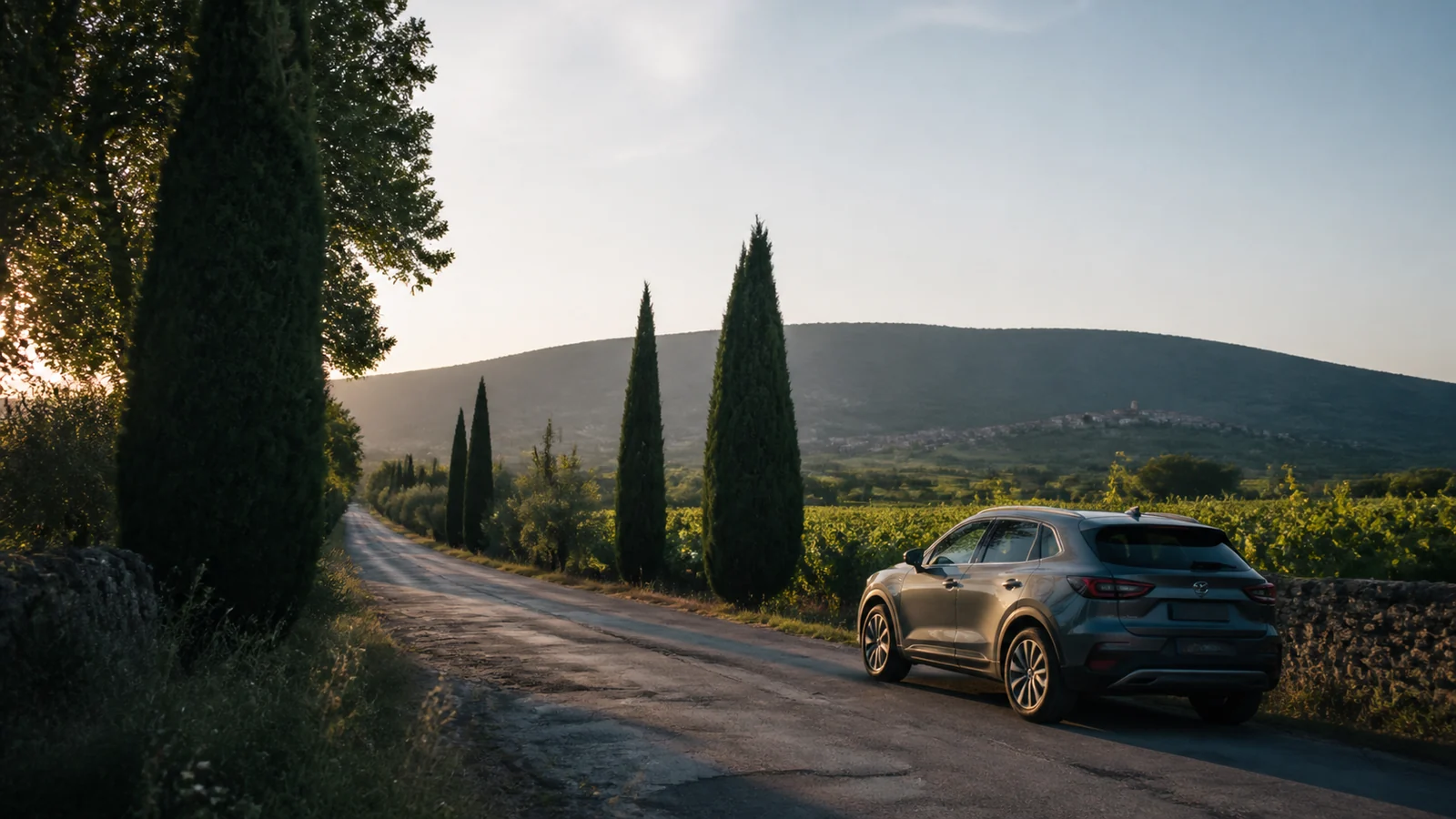
Build a realistic first journey
Saint-Nazaire to Guérande
Head west on the D213 toward the Guérande peninsula. The medieval walled town sits at the centre of working salt marshes. You can park outside the walls and explore the ramparts on foot.
Saint-Nazaire to La Baule
Take the D213 southeast to reach one of Europe's longest sandy beaches. The resort spreads along a wide bay, with Belle Époque architecture behind the shoreline. Arrive early in peak season to find parking near the beach.
Saint-Nazaire to Le Croisic and Batz-sur-Mer
Continue west past Guérande to the tip of the peninsula. Le Croisic is a working fishing port with Atlantic views, while Batz-sur-Mer offers a coastal path through the salt marshes.
Saint-Nazaire to Nantes
The A11 and A44 run east to Nantes, the regional capital. The city has a historic castle, the Jules Verne museum, and Les Machines de l'Île. It is worth a full day, so park near the centre and explore on foot.
Frequently asked questions
Is car hire in Saint-Nazaire better than relying on trains?
Saint-Nazaire has rail links to Nantes and Paris, but the coastal towns, salt marshes, and beaches are best reached by car. A rental vehicle gives you the freedom to stop at viewpoints and small villages along the way.
Do I need an international driving permit in France?
Most visitors with a standard EU photocard licence can drive legally. If your licence is issued outside the EU or does not use a Latin alphabet, an International Driving Permit is recommended as supporting documentation.
What documents should I bring to collect the car?
Take your driving licence, the credit card used for the booking, your passport or ID, and the printed or digital voucher. The supplier will also need to see proof of any additional insurance you purchased.
Compare Saint Nazaire car hire
Enter dates above, then compare pickup method, vehicle category and complete supplier terms before booking.
Continue planning with all France car hire locations, Paris Orly Airport Car Hire, Le Mans Car Hire, Calais Car Hire.