

Car Hire in Tours for Châteaux, Vineyards and the Loire Valley
Tours is the logical base for exploring the Loire Valley, a region of Renaissance châteaux, formal gardens, and vineyards that stretches along the river from Orléans to Angers. The city itself is pleasant and walkable, with a historic old quarter and good restaurants, but the real reason to hire a car here is the countryside that spreads in every direction. Within an hour's drive you can visit half a dozen major châteaux, stop at troglodyte wine cellars, and picnic beside the river.
Car hire suppliers in Tours usually operate from the city centre or near the main station. The exact pick-up point, opening hours, and return instructions will be listed on your voucher. Tours' compact centre means you can collect a vehicle and be on the A10 or A85 heading toward the châteaux within a short drive. Street parking in Vieux Tours is metered; use the underground car parks near Place Plumereau for longer visits.
Centre-Val de Loire, central France
Plan this first.
A10 to Paris/Bordeaux; A85 to Angers/Nantes
Confirm before booking.
Renaissance châteaux, Loire Valley vineyards, formal gardens
Confirm before booking.
Chenonceau, Amboise, Chambord, Villandry
Confirm before booking.
Match collection to the actual itinerary
Include transfers, parking days, opening hours and return timing when comparing the two options.
City-centre collection
Collecting in central Tours suits travellers arriving by TGV or staying in the old quarter. You can explore the medieval lanes and timbered houses on foot, then drive out to the châteaux when you are ready to leave the city behind.
Station or suburban pick-up
If your hotel sits outside the pedestrianised centre, a station-adjacent or suburban meeting point avoids city traffic and parking restrictions. Confirm the exact address on your voucher before setting out.
Plan the handover, price and first drive
The road from Tours to Chenonceau runs beside the Cher through farmland and woodland. The château appears suddenly, a long stone gallery built across the river on arches that look too slender to support it. In the quiet of early morning the water is still enough to mirror the entire building.
Amboise feels more lived-in than some of the grander châteaux. The royal residence sits above the town, while the Clos Lucé, Leonardo da Vinci's final home, hides behind garden walls a short walk away. The models of his flying machines and hydraulic pumps are displayed in the vaulted cellars.
Chambord is overwhelming in scale, a hunting lodge that grew into the largest château in the valley. The famous double-helix staircase allows two people to climb without meeting, a detail attributed to Leonardo. The rooftop terraces offer views across the estate's flat hunting park.
Vouvray is quieter, a wine village where the cellars are carved into the limestone cliffs above the river. Tastings happen in cool, vaulted rooms that feel more like caves than shops. The chenin blanc here ranges from dry and minerally to sweet and honeyed, depending on the vintage.
Check the conditions behind the price
The selected supplier’s terms and booking voucher control the rental. Review them before payment and again before collection.
Total payable price
Compare the full payable amount and inclusions rather than an unsupported daily-price promise.
Deposit and payment card
Confirm the deposit, accepted card type and whose name must appear on the card.
Excess and cover
Read the renter's liability, exclusions and what any optional protection actually changes.
Fuel policy
Know the collection level, return requirement and whether a refuelling charge can apply.
Mileage and territory
Check any distance limit and where the vehicle may be driven.
Extras and return
Price additional drivers, seats, after-hours service and one-way return before payment.
Choose for people, bags and roads
A category normally represents a group of similar cars, not a promise of one exact model.
- Compact: convenient for couples and tighter parking.
- Intermediate: more room for bags and longer journeys.
- Family or SUV category: useful only when the required capacity justifies it.
- Transmission: select automatic explicitly if manual is unsuitable.
Practical planning before departure
Peak season at the châteaux
Chenonceau, Chambord, and Amboise draw large crowds from May through September. Arrive before opening time to photograph the exteriors without tour buses in frame, and to secure parking.
Parking in Tours centre
Vieux Tours has metered street parking and several underground car parks. The one near Place Plumereau is convenient for the old town. Avoid driving into the narrow lanes around Rue Colbert unless your vehicle is compact.
Roundabout rules
France uses priority-to-the-right at unmarked junctions. On roundabouts, traffic already circulating has priority. Signal your exit and watch for cyclists on rural roads near the river.
Local access, road and operating conditions can change. Check current signs, your supplier instructions and the linked source before travelling: Loire Valley tourism.
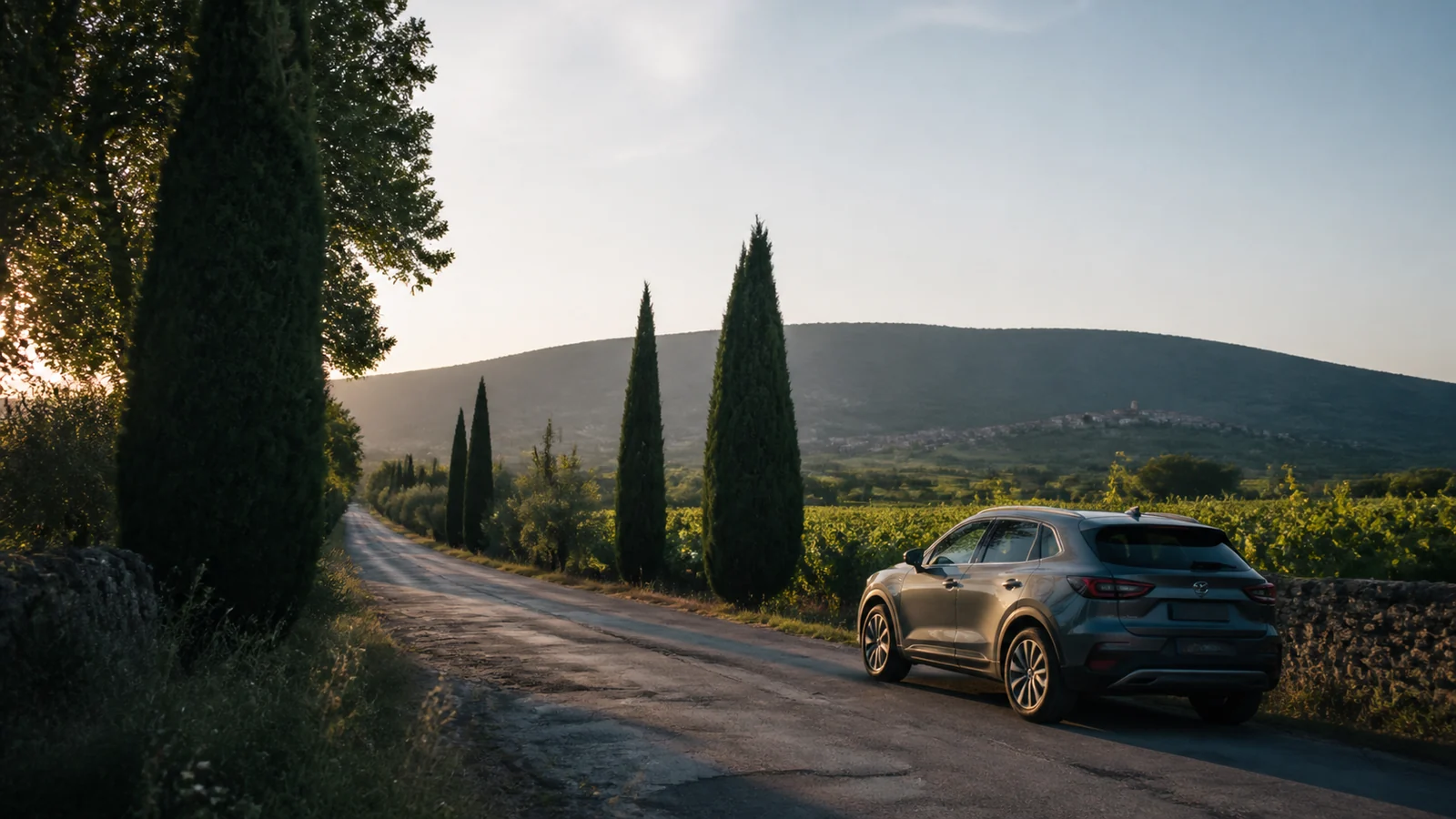
Build a realistic first journey
Tours to Chenonceau
Head east on the D751 along the Cher river. Chenonceau spans the water on stone arches and is one of the most photographed châteaux in France. Morning light is best for the river reflections.
Tours to Amboise
Take the D751 northeast to reach the royal château where François I entertained Leonardo da Vinci. The nearby Clos Lucé shows models of da Vinci's inventions. Both sites share a small car park that fills early.
Tours to Chambord and Blois
Drive east on the D925 to reach the largest Loire château, famous for its double-helix staircase. On the return leg, stop at Blois for its royal château and old-town squares.
Tours to Vouvray and Villandry
Northeast of Tours, Vouvray produces sparkling and still Chenin Blanc from cellars carved into the riverbank. West of Tours, Villandry has the most formal Renaissance gardens in France. Either makes a rewarding half-day trip.
Frequently asked questions
Is a car necessary for visiting the Loire Valley châteaux?
Tours has train connections to Blois and Amboise, but Chenonceau, Chambord, and the smaller châteaux are best reached by car. A rental vehicle also lets you stop at vineyards and viewpoints along the river that have no public transport.
What driving licence do I need in France?
Most EU photocard licences are accepted directly. Non-EU visitors should carry an International Driving Permit alongside their home licence, especially if the licence is not in a Latin alphabet.
What documents are required at pick-up?
Bring your driving licence, the credit card used for the reservation, your passport or national ID, and the booking voucher. The supplier may also ask for proof of any additional cover you purchased.
Compare Tours car hire
Enter dates above, then compare pickup method, vehicle category and complete supplier terms before booking.
Continue planning with all France car hire locations, Paris Orly Airport Car Hire, Le Mans Car Hire, Calais Car Hire.