

Car Hire Dubrovnik for the Dalmatian Coast and Beyond
Dubrovnik is the best-known destination on the Croatian coast, and a rental car opens the surrounding region that many visitors miss. The walled city itself is pedestrian-only in the centre, so a car is not needed for days spent inside the walls. It becomes essential when you plan to reach the Pelješac Peninsula, Montenegro, the Elaphiti Islands ferry ports or accommodation outside the compact old town. Begin with the [Croatia car hire guide] for country-wide rules, then compare the exact pickup location and return conditions for your dates.
A car helps with luggage transfers, early starts to beat the cruise-ship crowds, family trips to quieter beaches and any itinerary that extends beyond the city walls. It adds less value for a short city break focused on the Stradun, city walls and cable car. Choose a category that fits passengers and cases without being unnecessarily large. Coastal roads and old-town parking favour manageable dimensions, but the boot must still hold all luggage securely. The named model is normally an example rather than a guarantee.
Euro (EUR)
Plan this first.
Right-hand traffic
Confirm before booking.
Croatian
Confirm before booking.
Late spring through early autumn
Confirm before booking.
Match collection to the actual itinerary
Include transfers, parking days, opening hours and return timing when comparing the two options.
Dubrovnik City Centre
A city pickup suits travellers who arrive by bus, ferry or private transfer and want to start driving immediately. Check whether the desk is inside a hotel, at a port office or off-site with a shuttle. Confirm the parking situation at your accommodation before collecting the car.
Dubrovnik Airport
Air travellers can compare [car hire at Dubrovnik Airport] for the broadest vehicle choice. Include the desk location, shuttle requirements and return fuel policy in your decision, and allow extra time for summer queues.
Plan the handover, price and first drive
Dubrovnik is a city that reveals itself in layers. The first layer is the walls, the marble streets and the cable-car view that every visitor sees. The second layer is the coastline beyond the walls, the Konavle Valley to the south, and the Pelješac Peninsula to the north. The third layer is the hinterland that most tourists never reach, the villages where the population has halved since the war and the vineyards that produce wines known only to locals.
A rental car is the key to the second and third layers. It takes you to the oyster farms of Mali Ston, the wine cellars of Dingač, and the border crossing into Montenegro where the Bay of Kotor opens like a fjord. It allows you to leave the city before the cruise-ship crowds arrive and return after they have departed. It turns a standard city break into a regional exploration.
The practical challenges are real. Parking is expensive and limited, the old town is inaccessible by car, and the coastal road can be slow in summer. But the rewards are equally real. The driver who is willing to navigate narrow roads and find parking in small harbours will discover a Croatia that the bus tours miss.
Check the conditions behind the price
The selected supplier’s terms and booking voucher control the rental. Review them before payment and again before collection.
Total payable price
Compare the full payable amount and inclusions rather than an unsupported daily-price promise.
Deposit and payment card
Confirm the deposit, accepted card type and whose name must appear on the card.
Excess and cover
Read the renter's liability, exclusions and what any optional protection actually changes.
Fuel policy
Know the collection level, return requirement and whether a refuelling charge can apply.
Mileage and territory
Check any distance limit and where the vehicle may be driven.
Extras and return
Price additional drivers, seats, after-hours service and one-way return before payment.
Choose for people, bags and roads
A category normally represents a group of similar cars, not a promise of one exact model.
- Compact: convenient for couples and tighter parking.
- Intermediate: more room for bags and longer journeys.
- Family or SUV category: useful only when the required capacity justifies it.
- Transmission: select automatic explicitly if manual is unsuitable.
Practical planning before departure
Driving and Parking in Dubrovnik
Croatia drives on the right. The old town is pedestrian-only; driving inside the walls is restricted to residents and deliveries. Use signed public garages and read the current zone rules. Ask your accommodation for the approved arrival route if it sits in a restricted area.
Border Crossings to Montenegro
If your itinerary includes Montenegro, confirm that the rental agreement permits border crossings. Some suppliers charge a cross-border fee or require additional documentation. The border queue can be long in peak season, so allow extra time.
Vehicle Size for Coastal Roads
Coastal roads and village streets favour manageable dimensions, but baggage should remain secured in the boot. The supplied model may differ within the booked category.
Local access, road and operating conditions can change. Check current signs, your supplier instructions and the linked source before travelling: Dubrovnik Tourist Board.
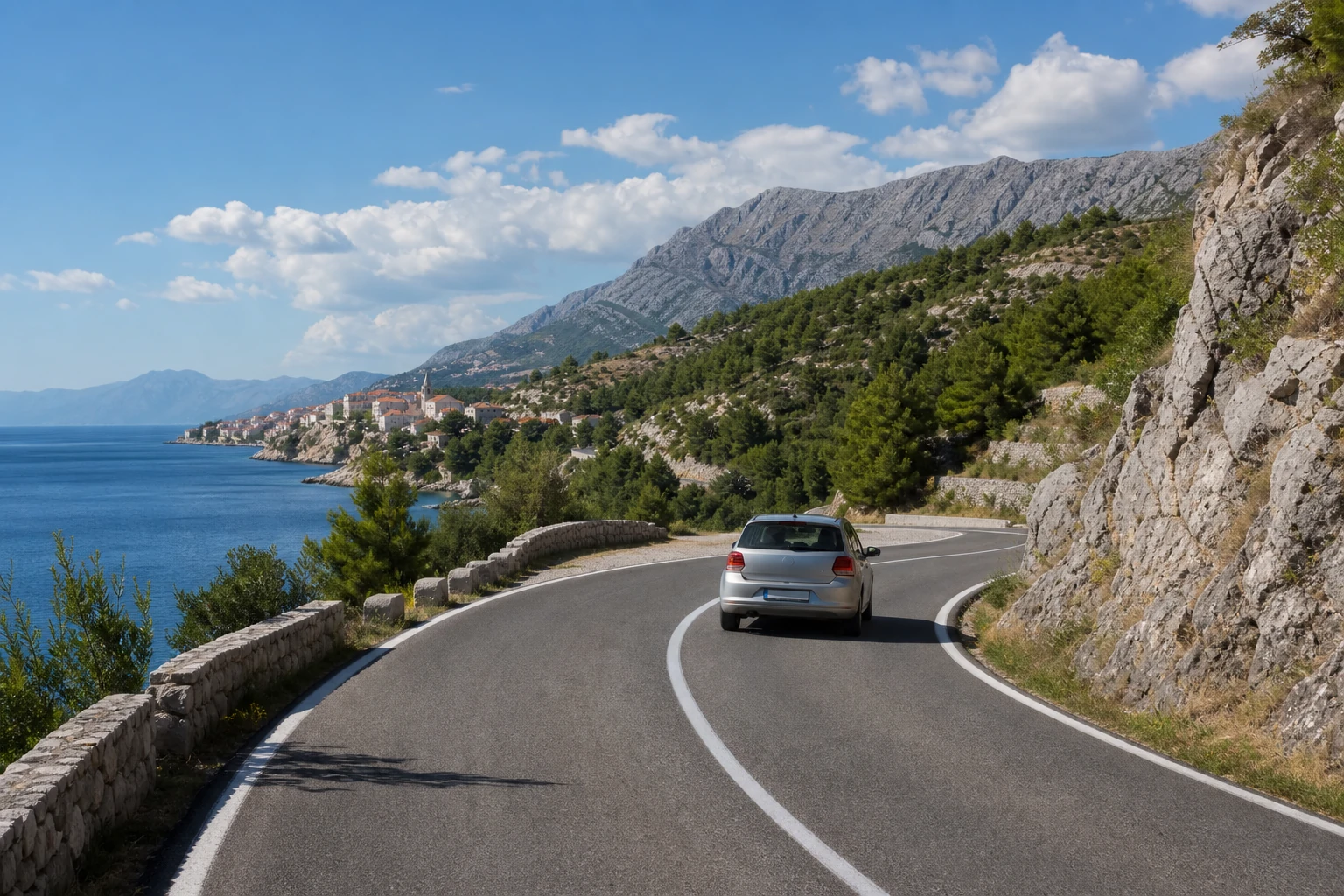
Build a realistic first journey
Dubrovnik to Montenegro
The coastal road south crosses the border at Debeli Brijeg and continues to Herceg Novi, Kotor and Budva. Check current entry requirements and confirm your rental includes Montenegro coverage before setting out.
Dubrovnik to Pelješac Peninsula
The road north crosses the bridge at Komarna to Croatia's wine country. Ston, with its medieval walls and oyster farms, is the usual first stop before continuing to the vineyards of Dingač and Postup.
Dubrovnik to Split
A longer coastal drive with several possible stops, including the Makarska Riviera and Krka National Park. Break the journey to avoid fatigue on narrow winding sections.
Dubrovnik to Lokrum and the Islands
Lokrum is reached by passenger ferry from the old port; cars are not permitted on the island. For vehicle access to Mljet or Korčula, check the current ferry schedules from Gruž or Trsteno ports.
Frequently asked questions
Do I need a car in Dubrovnik itself?
Not for the old town. The walls, Stradun and cable car are all walkable. A car becomes useful when you plan to explore outside the city or stay in accommodation without good bus connections.
Can I drive inside the old town walls?
No. The old town is pedestrian-only for non-residents. You must park in designated garages or lots outside the walls and walk in.
Can I take a rental car to Montenegro?
Some suppliers allow it with prior notice and a fee; others prohibit cross-border use. Confirm in writing before booking, because driving without permission voids your insurance.
What documents do I need at the border?
Passport, vehicle registration and rental permission letter are standard. Check the current entry rules for Montenegro, as they can change with little notice.
Where should I park in Dubrovnik?
Use signed public garages and follow the current zone rules. Garages near Pile Gate fill early in season; consider booking ahead or choosing accommodation with reserved parking.
Is there a fee for one-way rental to Split or Zagreb?
One-way charges vary by supplier and season. The search results show any extra cost before you confirm the booking, so compare return and one-way rates side by side.
Compare Dubrovnik car hire
Enter dates above, then compare pickup method, vehicle category and complete supplier terms before booking.
Continue planning with Croatia car hire guide, All car hire locations, Split Airport car hire, Zadar Car Hire.