

Gateway to the Dordogne and Rural France
Limoges is the porcelain capital of the world — a city of kilns and artisans in the heart of France. But beyond the china workshops, this is gateway country: the Dordogne to the south, the Massif Central to the east, the Atlantic coast to the west. With a hire car, you can explore some of France's most beautiful villages, taste foie gras in Périgord, and discover a region that tourists often overlook entirely.
Limoges sits at the centre of Nouvelle-Aquitaine, France's largest region. Without a car, you're limited to the city and slow regional trains with infrequent schedules. With wheels, the Dordogne valley — one of France's most beautiful regions — opens up within an hour. The Limousin countryside offers lakes, forests, and villages that see almost no foreign visitors. Bordeaux lies to the west, the Atlantic coast beyond it. This is authentic rural France, and a car is the most practical way to experience it properly.
Limoges-Bellegarde (LIG)
Plan this first.
Dordogne, Limousin lakes, rural France
Confirm before booking.
A20 motorway and scenic D roads
Confirm before booking.
Porcelain, enamel, and medieval heritage
Confirm before booking.
Match collection to the actual itinerary
Include transfers, parking days, opening hours and return timing when comparing the two options.
Airport Collection
Limoges-Bellegarde Airport sits timing that varies with traffic and conditions west of the city centre. It is a compact regional airport with a short walk from terminal to car park. All major hire companies maintain desks here, and the collection process is typically quick. The airport offers available rental rates compared to larger hubs, making it a practical starting point for a rural French road trip.
City Centre Alternative
Several rental agencies have offices in Limoges city centre, particularly around the railway station. If you are arriving by TGV from Paris, collecting in town may save a taxi transfer. The city is compact, but the surrounding countryside is where a car truly proves its worth.
Plan the handover, price and first drive
Limoges has been synonymous with fine china since the 18th century, when deposits of kaolin clay were discovered nearby. The city's workshops supplied porcelain to royal courts across Europe, and that heritage continues in the dozen or so active factories still operating today. But Limoges is considerably more than ceramics. Founded by the Romans as Augustoritum, the city grew around a major abbey and became an important centre for religious scholarship and enamelwork during the Middle Ages.
The Gothic Cathédrale Saint-Étienne dominates the old town, its spire visible from across the city. The Quartier de la Boucherie, the former butchers' quarter, retains timber-framed houses and a network of narrow lanes that feel medieval. The Chapelle Saint-Aurélien, tucked into this quarter, contains a relic of the city's patron saint and is one of Limoges' hidden gems.
Beyond the city, the Limousin region is a landscape of lakes and forests, barely known outside France. Lake Vassivière, an hour east, is one of the largest artificial lakes in the country, with an outdoor sculpture park on an island in its centre. The Monts de Châlus, further southwest, offer walking trails through oak forests where cattle still graze under traditional woodland management. This is rural France at its most authentic — no tourist coaches, no English menus, just countryside that has changed little in centuries.
South of Limoges, the Dordogne valley opens up like a different country. Here the limestone cliffs shelter some of humanity's oldest art — the caves at Lascaux, discovered by teenagers in 1940, contain paintings of horses and bison created 17,000 years ago. The valley's medieval villages — Sarlat, La Roque-Gageac, Beynac — are among the most photographed in France. A car from Limoges puts all of this within easy reach, along with the foie gras, truffles, and walnut wine that make this region a gastronomic destination.
Check the conditions behind the price
The selected supplier’s terms and booking voucher control the rental. Review them before payment and again before collection.
Total payable price
Compare the full payable amount and inclusions rather than an unsupported daily-price promise.
Deposit and payment card
Confirm the deposit, accepted card type and whose name must appear on the card.
Excess and cover
Read the renter's liability, exclusions and what any optional protection actually changes.
Fuel policy
Know the collection level, return requirement and whether a refuelling charge can apply.
Mileage and territory
Check any distance limit and where the vehicle may be driven.
Extras and return
Price additional drivers, seats, after-hours service and one-way return before payment.
Choose for people, bags and roads
A category normally represents a group of similar cars, not a promise of one exact model.
- Compact: convenient for couples and tighter parking.
- Intermediate: more room for bags and longer journeys.
- Family or SUV category: useful only when the required capacity justifies it.
- Transmission: select automatic explicitly if manual is unsuitable.
Practical planning before departure
Driving to the Dordogne
Head south on the A20 and connect to the D704 toward Sarlat-la-Canéda. The landscape shifts from Limousin farmland to limestone cliffs, walnut groves, and medieval bastide towns. This is one of France's most scenic driving regions, especially in autumn when the valleys turn golden.
Limousin Lakes
The region around Limoges contains numerous lakes created by damming the Vienne River. Lake Saint-Pardoux, timing that varies with traffic and conditions north, offers beaches, watersports, and forest walks. The drive there passes through rolling green countryside typical of this under-visited part of France.
Oradour-sur-Glane
This martyred village, preserved as a memorial since the 1944 massacre, lies timing that varies with traffic and conditions northwest. The approach is through quiet farmland. It is a sombre but important site, and the village is left exactly as it was found after the tragedy.
Bordeaux and the Atlantic
The wine capital lies west on the A89 motorway. Beyond Bordeaux, the Atlantic coast offers surf beaches at Lacanau, the oyster town of Arcachon, and the vast dunes of the Landes forest. This makes a natural extension to a Limoges-based trip.
Local access, road and operating conditions can change. Check current signs, your supplier instructions and the linked source before travelling: Limoges Tourism.
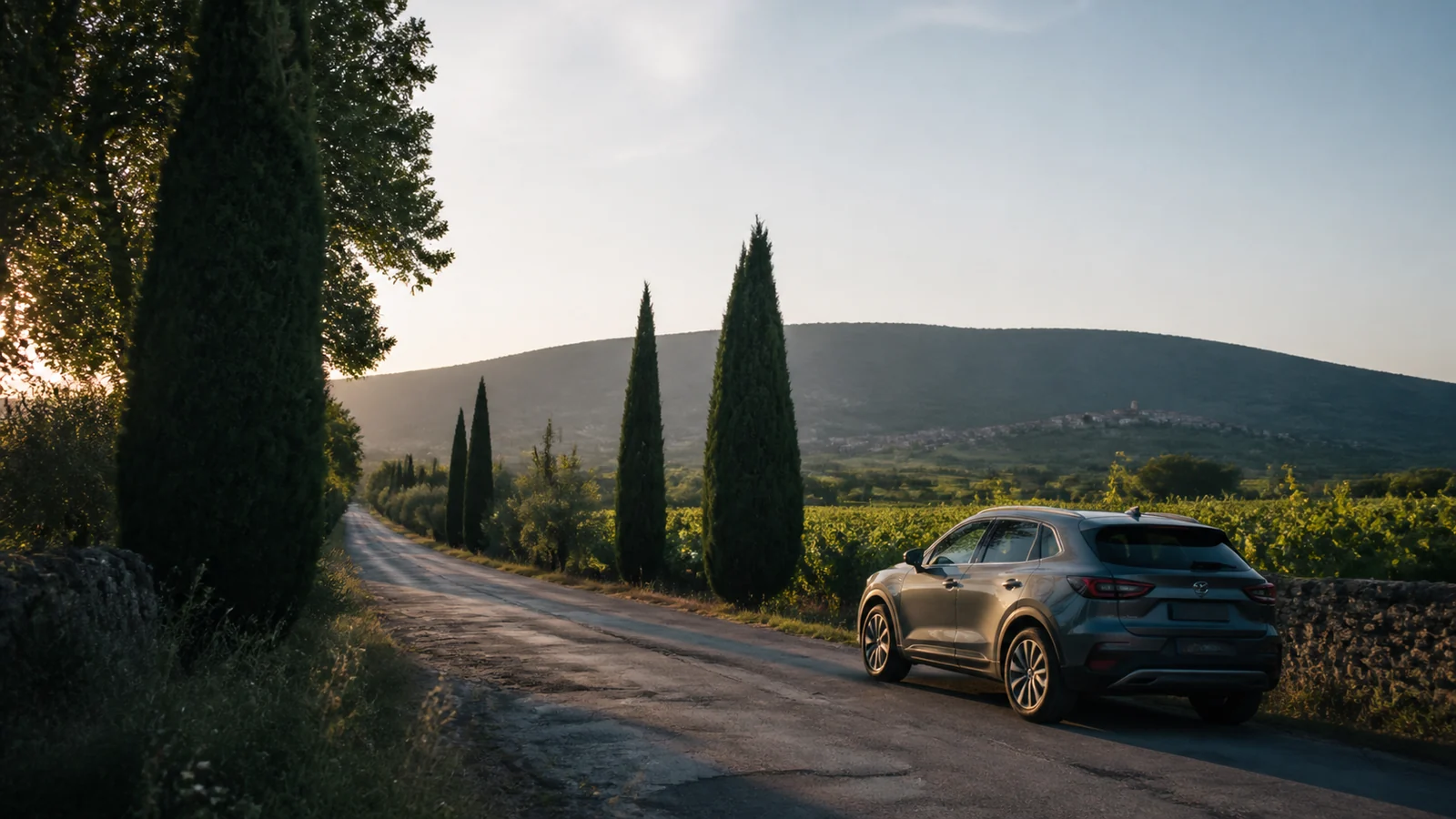
Build a realistic first journey
Dordogne Valley Circuit
Drive south through Brive-la-Gaillarde, then follow the Dordogne River east through Souillac, Sarlat, and Domme. Each village offers something different — caves, castles, markets, or simply a perfect view from a terrace café. Allow a full day minimum.
Limousin Lake Loop
Head north to Lake Saint-Pardoux, then loop east through the Monts de Blond — low hills with views across the region. Continue south through the Mortemart, officially one of France's most beautiful villages, before returning to Limoges.
Cognac and Angoulême
Drive southwest to Cognac for distillery tours, then continue to Angoulême — a hilltop city famous for comic strip murals and a spectacular Romanesque cathedral. The route passes through vineyards and sunflower fields, classic French countryside.
Frequently asked questions
Is Limoges a good base for exploring the Dordogne?
Yes — Limoges sits roughly an hour north of the Dordogne valley by car. The A20 motorway connects directly, and from there you can branch into the valley's network of scenic D roads. It is less crowded than starting from Bergerac or Sarlat, and car hire rates are typically lower.
What is Limoges famous for besides porcelain?
Limoges has a rich medieval heritage, including the Gothic Cathédrale Saint-Étienne and the Quartier de la Boucherie — a former butchers' quarter with timber-framed houses. The city also has a tradition of enamelwork dating back centuries. The Adrien Dubouché museum houses one of the world's finest porcelain collections.
Are the roads around Limoges easy to drive?
Yes — the surrounding countryside has well-maintained roads and light traffic outside rush hours. The A20 and A89 motorways connect to major destinations. Rural D roads are narrow in places but generally good quality. Satellite navigation is recommended for finding smaller villages.
Can I drive from Limoges to Bordeaux in a day?
Easily — Bordeaux is roughly 2.timing that varies with traffic and conditions west on the A89 motorway. This makes it feasible as a day trip for wine tasting, though an overnight stay lets you explore the city properly. The route passes through the Périgueux wine region, worth a stop in its own right.
Compare Limoges car hire
Enter dates above, then compare pickup method, vehicle category and complete supplier terms before booking.
Continue planning with Car Hire France Guide, all France car hire locations, Paris Orly Airport Car Hire, Le Mans Car Hire.