

Hire a Car in Tinos and Discover the Artisan Cyclades
Tinos is the island of dovecotes and marble, of pilgrimage churches and hidden coves, of terraced hills and villages where sculptors still work in the tradition of their ancestors. It sits in the northern Cyclades, a short ferry ride from Mykonos, yet it feels far removed from the party scene of its neighbour. The main town is dominated by the Church of Panagia Evangelistria, one of the most important shrines in Greece, but Tinos rewards the visitor who drives inland — to the marble villages of Pyrgos and Ysternia, to the granite landscape of Volax, and to the quiet beaches of the north coast that most tourists never reach.
We compare deals from operators in Tinos Town, the main port and commercial centre. A car is the practical way to explore an island that stretches across varied terrain, from the busy harbour to the agricultural interior and the wilder northern shore. Book ahead in August, when pilgrim traffic and summer visitors converge.
Cyclades
Plan this first.
Tinos Town
Confirm before booking.
Marble villages, pilgrimage sites, dovecotes, quiet beaches
Confirm before booking.
Interior roads can be narrow and steep; allow extra time for mountain village routes
Confirm before booking.
Match collection to the actual itinerary
Include transfers, parking days, opening hours and return timing when comparing the two options.
Tinos Town: Pilgrimage, Port and Old Quarter
Tinos Town is built around the harbour and the grand church of Panagia Evangelistria, which draws thousands of pilgrims each year, many crawling up the marble steps on their knees. The interior is a remarkable space of votive offerings, silver and gold. Behind the church, the old quarter has a more everyday feel — shops, cafes and a waterfront that handles ferries from Rafina, Piraeus and Mykonos. The town is pleasant to walk, but the real Tinos lies beyond.
The Interior: Marble, Dovecotes and Granite
The villages of Pyrgos, Ysternia and Kardiani are built almost entirely of local marble, with carved fountains, archways and doorways that show the skill of Tinian sculptors. Pyrgos is home to the Museum of Tinian Artists and the grave of Giannoulis Halepas, Greece’s most celebrated marble carver. The valley of Tarambados holds over forty dovecotes — decorative stone towers built to house pigeons, unique to Tinos. And at Volax, enormous granite boulders surround a village famous for its basket-weavers, creating one of the most unusual landscapes in Greece.
Plan the handover, price and first drive
Tinos has been a place of marble and faith for millennia. The island’s quarries supplied stone for sculpture and architecture across the ancient world, and the tradition of marble carving continues in the villages of Pyrgos and Ysternia, where workshops still produce works for churches, public spaces and private commissions. The Museum of Tinian Artists in Pyrgos celebrates this heritage, and the grave of Giannoulis Halepas — who overcame mental illness to create some of Greece’s most moving sculptures — is a place of pilgrimage in its own right.
The dovecotes are another Tinian peculiance — over six hundred decorative stone towers scattered across the island, built not just for function but as expressions of folk architecture. The best concentration is in the valley of Tarambados, where dozens of these structures create a landscape found nowhere else in Greece.
And then there is the spiritual side. The Church of Panagia Evangelistria is one of the most important shrines in the Orthodox world, drawing thousands of pilgrims each year, many of whom make the journey on foot from the port. But Tinos is not only a place of devotion. It is an island of farmers, sculptors, basket-weavers and fishermen — a community that has found ways to maintain its traditions while welcoming visitors who come by ferry from Mykonos and beyond. A hire car is the link between these worlds, the tool that lets you move from the busy harbour to the quiet villages and the empty northern coast in a single day.
Check the conditions behind the price
The selected supplier’s terms and booking voucher control the rental. Review them before payment and again before collection.
Total payable price
Compare the full payable amount and inclusions rather than an unsupported daily-price promise.
Deposit and payment card
Confirm the deposit, accepted card type and whose name must appear on the card.
Excess and cover
Read the renter's liability, exclusions and what any optional protection actually changes.
Fuel policy
Know the collection level, return requirement and whether a refuelling charge can apply.
Mileage and territory
Check any distance limit and where the vehicle may be driven.
Extras and return
Price additional drivers, seats, after-hours service and one-way return before payment.
Choose for people, bags and roads
A category normally represents a group of similar cars, not a promise of one exact model.
- Compact: convenient for couples and tighter parking.
- Intermediate: more room for bags and longer journeys.
- Family or SUV category: useful only when the required capacity justifies it.
- Transmission: select automatic explicitly if manual is unsuitable.
Practical planning before departure
Driving in Tinos
Traffic drives on the right. The main road from Tinos Town to the interior villages is paved and generally in good condition, but side roads can be narrow, steep and poorly signposted. The mountain routes around Exomvourgo and the northern coast require confident driving. Parking in Tinos Town is challenging during pilgrimage periods and August; many visitors leave the car at the edge of the centre.
Ferry and Access
Tinos is well connected by ferry from Piraeus, Rafina and Mykonos. The crossing from Rafina takes around two hours, while Mykonos is only thirty minutes away. The port is in Tinos Town. If you are island-hopping, check whether your rental operator allows cross-island drop-off or requires return to Tinos.
Beach and Sightseeing Routes
The road north from Tinos Town runs through agricultural land to the beaches of Kolibithra and the quieter coves beyond. The interior route through Komi to Pyrgos and Ysternia is slower but scenic, passing dovecotes, marble workshops and terraced hillsides. The road to Volax and Exomvourgo climbs into a landscape of granite boulders and medieval ruins.
Local access, road and operating conditions can change. Check current signs, your supplier instructions and the linked source before travelling: Visit Greece.
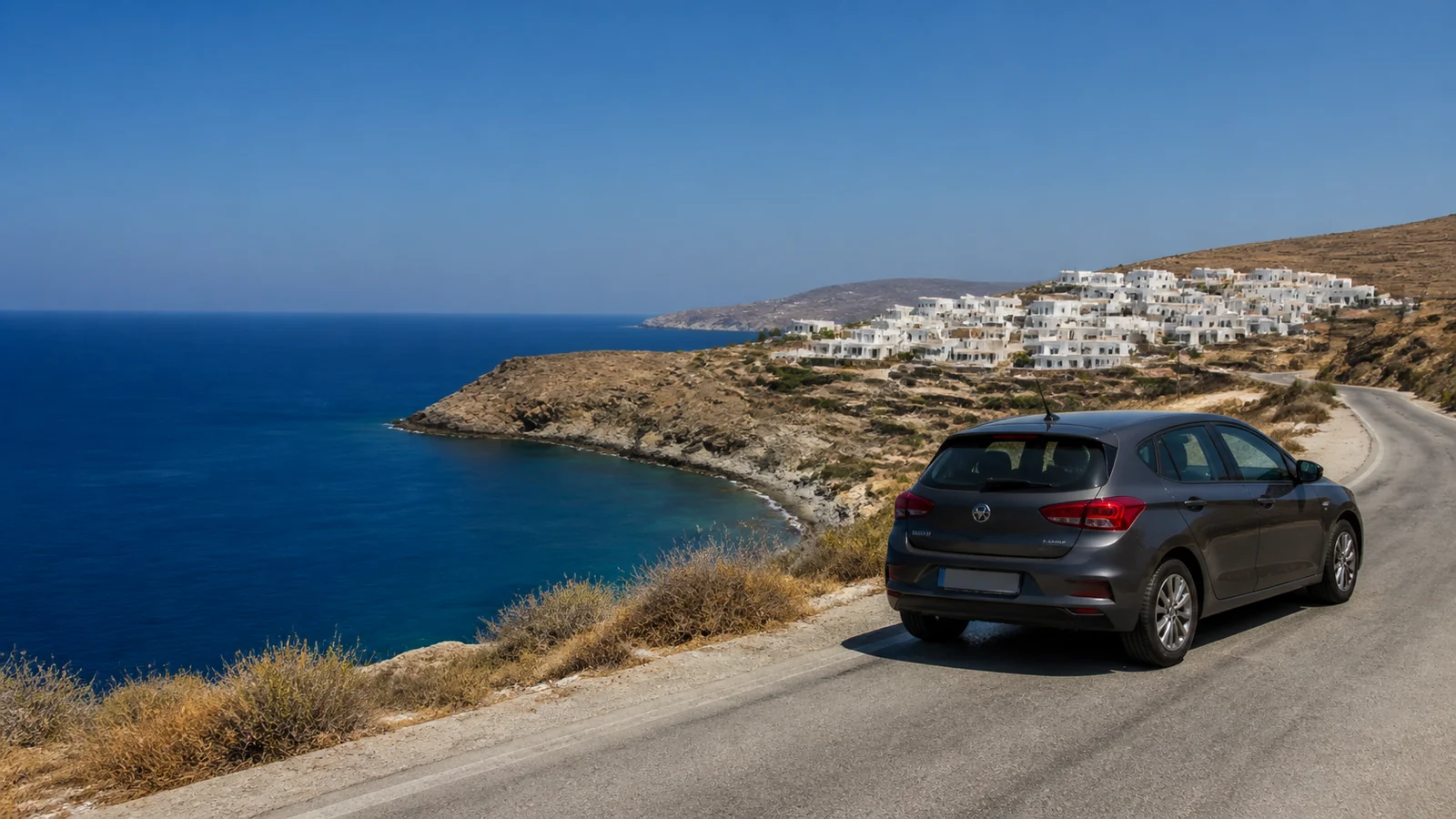
Build a realistic first journey
Tinos Town to Pyrgos and Ysternia
Drive inland from the port through Komi and up into the marble villages of the north-west. Pyrgos is the centre of Tinos’s sculptural tradition, with a museum, marble workshops and the grave of Halepas. Ysternia, further west, has views across the Aegean to Syros and a small square shaded by plane trees. The road is winding and steep in places, but the villages repay the effort.
Tinos Town to Volax and Exomvourgo
Head east from the town towards the extraordinary granite landscape of Volax, where house-sized boulders create a terrain unlike anything else in the Cyclades. The nearby rock of Exomvourgo holds the ruins of a medieval citadel and a Venetian castle, with a challenging climb to the summit for those who want the view. The road is narrow and the final approach to Exomvourgo is on foot.
Tinos Town to Kolibithra and the North Coast
Follow the road north through agricultural valleys to the beach at Kolibithra, a long stretch of sand with views of the nearby islets. The north coast is quieter than the south and has a wilder character, with fewer facilities and more open landscape. The road is generally good but can be busy with agricultural traffic during harvest periods.
Frequently asked questions
Is it worth hiring a car in Tinos?
Yes. Tinos is larger and more varied than it appears, and the best beaches, villages and landscapes are spread across the island. Public transport exists but is limited, particularly for the northern coast and interior villages. A car lets you explore at your own pace and avoid the crowds at the most famous sites.
Can I pick up a car at Tinos Port?
Most operators have offices or meeting points in Tinos Town, near the port. Some offer hotel delivery. Book ahead, particularly during religious festivals and in August, when demand is highest and vehicle numbers are limited.
What type of car is best for Tinos?
A compact car is sufficient for the main roads and most village routes. If you plan to explore rougher northern tracks or travel with a larger group, a vehicle with more clearance and space is worth considering. Automatics should be reserved well ahead.
Are there tolls or fuel stations to worry about?
Tinos has no toll roads. Fuel stations are found in Tinos Town and along the main road network, but remote villages and the northern coast may have none. Fill up in town before heading to the interior or the quieter beaches.
Do I need an International Driving Permit?
Most non-EU visitors will need an International Driving Permit alongside their home licence to hire and drive in Greece. EU licence holders can generally use their national licence. Check with your rental operator before travel.
Compare Tinos Island car hire
Enter dates above, then compare pickup method, vehicle category and complete supplier terms before booking.
Continue planning with all Greece car hire locations, Car Hire Thessaloniki Airport, Car Hire Neapoli Voion, Skopelos Car Hire.