

Car Hire in Tinos — Villages, Crafts and Sacred Traditions
Tinos is the Cyclades island that pilgrims and artists have treasured for centuries: marble quarries that supplied ancient sculptors, dovecote villages of extraordinary beauty, and one of Greece's most important religious shrines. A hire car lets you move between these worlds—sacred and secular, coastal and mountain—with the freedom that defines a proper Greek island holiday.
The island's reputation rests on three pillars: the church of Panagia Evangelistria, the marble craftsmanship of Pyrgos, and the traditional villages scattered across its interior. Public transport connects the port to the main town, but the villages, beaches, and mountain viewpoints need a car. Whether you're here for pilgrimage, art, or simple relaxation, having your own wheels transforms the experience.
Cultural exploration + village-hopping
Plan this first.
Good main roads; village lanes are narrow
Confirm before booking.
Free in villages; busy near Panagia Evangelistria
Confirm before booking.
Visit Pyrgos for marble workshops and galleries
Confirm before booking.
Match collection to the actual itinerary
Include transfers, parking days, opening hours and return timing when comparing the two options.
Compact car for town, port and villages
Tinos's villages were built for donkeys, not cars. A compact vehicle is essential for navigating narrow lanes, squeezing into tight parking spots, and turning around in village squares. Perfect for a culture-focused itinerary centred on Pyrgos, Volax, and the main town.
Larger car for groups, luggage and longer stays
If you're travelling with family, carrying marble souvenirs, or staying for a week or more, a larger car adds comfort and boot space. Useful for airport connections and day trips to neighbouring islands via ferry.
Plan the handover, price and first drive
Tinos is an island of contradictions, and that's its charm. In the same day you can watch a pilgrim crawl on hands and knees up the sacred hill to Panagia Evangelistria, and an hour later watch a sculptor carve marble in Pyrgos using techniques unchanged since Phidias.
The dovecotes are the island's signature architecture—tall stone towers with geometric patterns that served both practical and decorative purposes. They're everywhere once you start looking, hidden in fields, perched on hillsides, each one unique.
Then there's the food. Tinos has some of the best traditional cooking in the Cyclades, partly because it never became a mass-tourism island. The local sausages, the artichoke dishes, the marzipan-like sweets called amygdalota—all made with local pride and served without pretension.
A rental car is what lets you stitch these experiences together. Drive to a village for coffee, to a beach for a swim, to a mountaintop chapel for sunset. Tinos rewards the curious, and a car is your key to curiosity.
Check the conditions behind the price
The selected supplier’s terms and booking voucher control the rental. Review them before payment and again before collection.
Total payable price
Compare the full payable amount and inclusions rather than an unsupported daily-price promise.
Deposit and payment card
Confirm the deposit, accepted card type and whose name must appear on the card.
Excess and cover
Read the renter's liability, exclusions and what any optional protection actually changes.
Fuel policy
Know the collection level, return requirement and whether a refuelling charge can apply.
Mileage and territory
Check any distance limit and where the vehicle may be driven.
Extras and return
Price additional drivers, seats, after-hours service and one-way return before payment.
Choose for people, bags and roads
A category normally represents a group of similar cars, not a promise of one exact model.
- Compact: convenient for couples and tighter parking.
- Intermediate: more room for bags and longer journeys.
- Family or SUV category: useful only when the required capacity justifies it.
- Transmission: select automatic explicitly if manual is unsuitable.
Practical planning before departure
Driving in Tinos
Greece drives on the right. The main road from the port to Pyrgos is wide and well maintained, but village streets are narrow and often steep. Watch for pilgrims walking to the church, especially on religious holidays.
Parking near religious sites
Panagia Evangelistria draws thousands of pilgrims, particularly on August 15. Parking is organised but busy—arrive early or use the designated car parks rather than street spaces.
Marble and souvenirs
Tinos marble is heavy. If you're buying sculptures or decorative pieces, ensure your rental car has adequate boot space and secure wrapping. Some workshops can arrange shipping if you prefer.
Ferry connections
Tinos is well connected to Rafina, Piraeus, Mykonos, Syros, and Andros. The main port is at Chora. If you're island-hopping, check ferry schedules and port locations so your car rental aligns with your travel plans.
Local access, road and operating conditions can change. Check current signs, your supplier instructions and the linked source before travelling: Greece official tourism information.
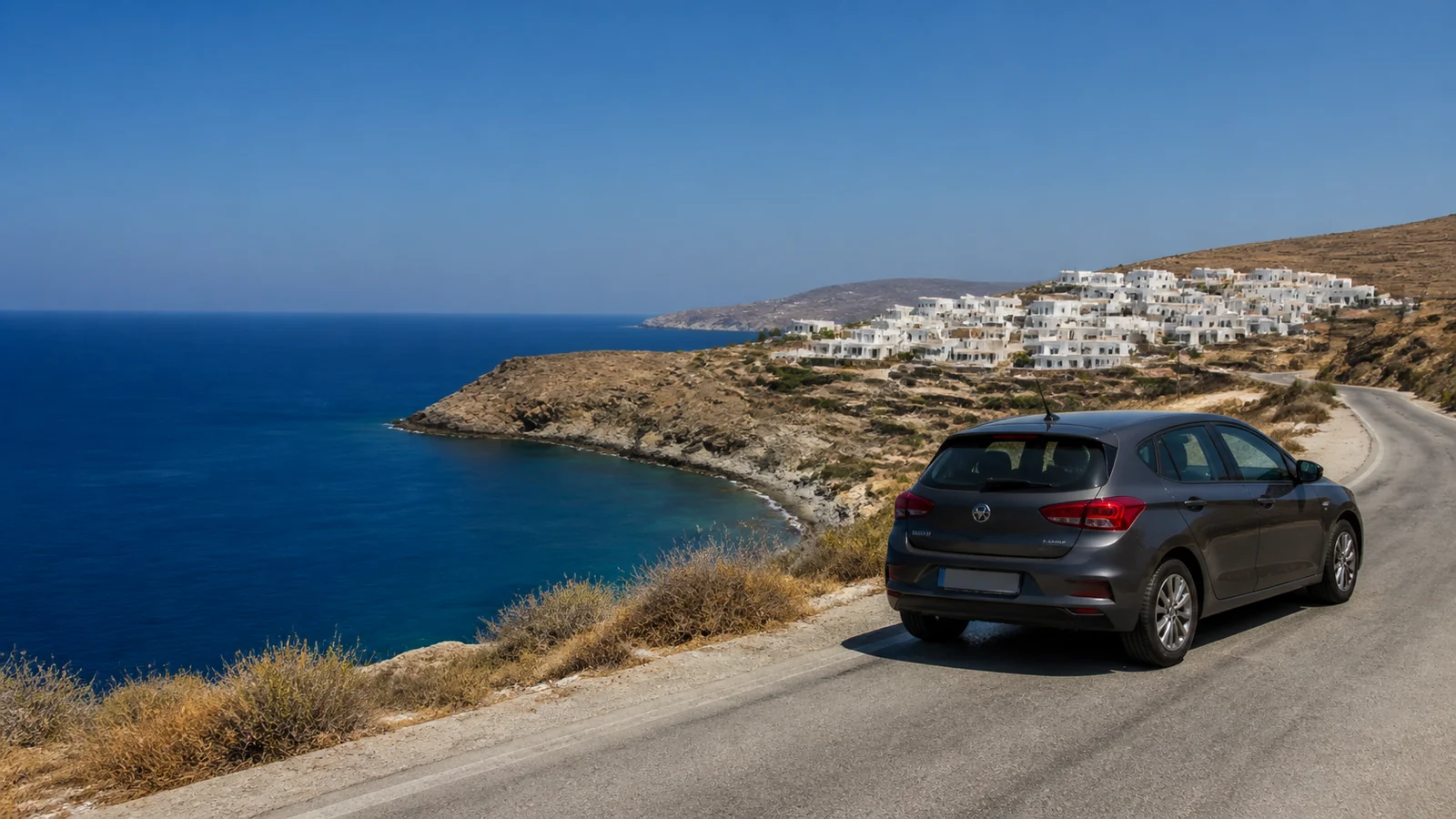
Build a realistic first journey
Chora to Pyrgos and the marble country
Drive north-west from the port to Pyrgos, Greece's marble capital. Stop at the Museum of Marble Crafts, visit working workshops, and admire the village's ornate carved facades. The road winds through terraced hills and offers sea views at every turn.
Volax and the inland villages
Head inland to Volax, a village famous for its round granite boulders and traditional basket-weaving. The surrounding area is dotted with other small settlements, each with its own church, café, and story. A slow, rewarding drive.
Coastal road to Panormos and beyond
Follow the north coast for a string of quieter beaches and fishing villages. Panormos is the main settlement, with tavernas and a small harbour. Further east, the coast becomes wilder and less developed—ideal for a peaceful afternoon away from the crowds.
Frequently asked questions
Is Tinos worth visiting if I'm not religious?
Absolutely. The island's marble heritage, traditional villages, and unspoiled beaches are reason enough. The religious sites add atmosphere but don't dominate unless you seek them out.
Do I need a car for the villages?
Yes. Buses serve the main road, but villages like Pyrgos and Volax are much easier to reach by car. Taxis are available but expensive for multiple stops.
When is the best time to visit Tinos?
Spring and early summer (April–June) are ideal—warm weather, green landscapes, and fewer crowds. July and August are hot and busy with pilgrims. September is also excellent.
Can I buy marble souvenirs and take them home?
Yes, but consider weight and fragility. Many workshops offer small pieces suitable for luggage, or can arrange professional shipping for larger items.
Where do I collect my rental car?
Most rentals are collected near the port at Chora or at the island's small airport. Your voucher will confirm the exact location.
Is Tinos crowded?
The port town can be busy, especially around religious festivals. The villages and remote beaches remain peaceful even in peak season—another reason to have a car.
Compare Tinos car hire
Enter dates above, then compare pickup method, vehicle category and complete supplier terms before booking.
Continue planning with All car hire locations, Car Hire Thessaloniki Airport, Car Hire Neapoli Voion, Skopelos Car Hire.