

Car Hire in Le Havre — Base for the Alabaster Coast
Le Havre is France's second-largest port and one of its most striking modern cities. Rebuilt after the Second World War by the architect Auguste Perret, it is a UNESCO World Heritage site of concrete, light and geometric precision. But for most visitors the real draw is what lies outside the city — the chalk cliffs of Etretat, the D-Day beaches to the west, and the picturesque ports of Honfleur and Fécamp. With a rental car you can see all of it at your own pace, from the dramatic coastline to the quiet cider farms of the Pays de Caux.
Le Havre's city centre is laid out on a grid, which makes navigation straightforward even for first-time visitors. The Perret architecture is worth seeing — wide avenues, tower blocks with ocean views, and the striking Saint-Joseph church with its lantern tower. Parking is affordable by Parisian standards, with underground car parks in the centre and street parking on the outskirts. The A131 connects Le Havre to the A29 and A13 autoroutes, giving fast links to Rouen and Paris. The real pleasure of driving from here is the coastal route, the D940, which runs along the Alabaster Coast past cliff formations, beach resorts and fishing villages. These roads are scenic but winding, so allow extra time for photo stops and for navigating the narrow sections through coastal towns.
Normandy
Plan this first.
Seine-Maritime
Confirm before booking.
Coastal cliffs, D-Day history, port towns
Confirm before booking.
D940 Alabaster Coast
Confirm before booking.
Match collection to the actual itinerary
Include transfers, parking days, opening hours and return timing when comparing the two options.
Port or city-centre pickup
Collecting your rental car near the port or in the city centre puts you right on the main road network. You can be on the D940 towards Etretat within minutes, or on the autoroute to Rouen and Paris if you are heading inland. The port area has clear signage and several fuel stations. Return the car to the same point, or ask your supplier about one-way rentals if you are ending your trip elsewhere in Normandy.
Normandy coast and history
A car from Le Havre opens up the whole of northern Normandy. You can drive the Alabaster Coast to Etretat and Fécamp, explore the D-Day landing beaches and cemeteries west of the city, or cross the Pont de Normandie to Honfleur and the Seine estuary. Inland, the Pays de Caux offers cider farms, manor houses and quiet country lanes. The key advantage is flexibility — you are not tied to tour schedules or train times.
Plan the handover, price and first drive
Le Havre was obliterated in 1944, then rebuilt from scratch in a style that divided opinion for decades. Today the concrete city centre is a UNESCO site, recognised for its bold post-war planning and the way Perret used light and space to create something genuinely new.
Most travellers pass through quickly, heading for the cliffs or the ferry. But the city has its own rewards — the Musée d'Art Moderne André Malraux has one of France's finest collections of Impressionist works, and the seafront promenade is a pleasant place to stroll on a summer evening.
With a rental car the real Normandy begins at the city limits. Etretat's cliffs are half an hour away. Honfleur is forty minutes east. The D-Day beaches are an hour west. You can drive the coast in a day, or take a week to explore the cider farms, manor houses and small ports that lie inland.
The light on the Alabaster Coast is famous — pale, soft, changing with the weather and the tides. It is the light that drew the Impressionists, and it is still the reason photographers come here today. A car lets you chase that light from one viewpoint to the next, stopping when the mood takes you.
Check the conditions behind the price
The selected supplier’s terms and booking voucher control the rental. Review them before payment and again before collection.
Total payable price
Compare the full payable amount and inclusions rather than an unsupported daily-price promise.
Deposit and payment card
Confirm the deposit, accepted card type and whose name must appear on the card.
Excess and cover
Read the renter's liability, exclusions and what any optional protection actually changes.
Fuel policy
Know the collection level, return requirement and whether a refuelling charge can apply.
Mileage and territory
Check any distance limit and where the vehicle may be driven.
Extras and return
Price additional drivers, seats, after-hours service and one-way return before payment.
Choose for people, bags and roads
A category normally represents a group of similar cars, not a promise of one exact model.
- Compact: convenient for couples and tighter parking.
- Intermediate: more room for bags and longer journeys.
- Family or SUV category: useful only when the required capacity justifies it.
- Transmission: select automatic explicitly if manual is unsuitable.
Practical planning before departure
Driving the Alabaster Coast
The D940 from Le Havre to Etretat and beyond is one of France's great coastal drives. The road hugs the cliff tops, with views of the Channel, chalk stacks and natural arches. It is well maintained but narrow in places, with tight bends through villages. Etretat itself gets extremely busy in July and August — arrive before 10 am or after 5 pm to avoid the worst congestion. Parking at the top of the town is usually easier than trying to find a space near the beach.
Parking in Le Havre
Central Le Havre has several underground car parks, typically charging modest hourly rates. Street parking is available further out. Near the port, long-stay parking is useful if you are taking a ferry. If you are staying in the city and exploring on foot, park once and walk — the centre is compact and the seafront is pleasant on foot.
Fuel and services
Le Havre has plenty of fuel stations, especially near the port and on the main autoroute junctions. Supermarket pumps usually offer the the quoted price for the selected datess. Shops in the centre follow standard French hours, closing at lunchtime on Sundays and early on weekdays. If you are heading out to the coast for the day, fill up before you leave — village garages are scarce on the cliff roads.
Local access, road and operating conditions can change. Check current signs, your supplier instructions and the linked source before travelling: Le Havre Tourism.
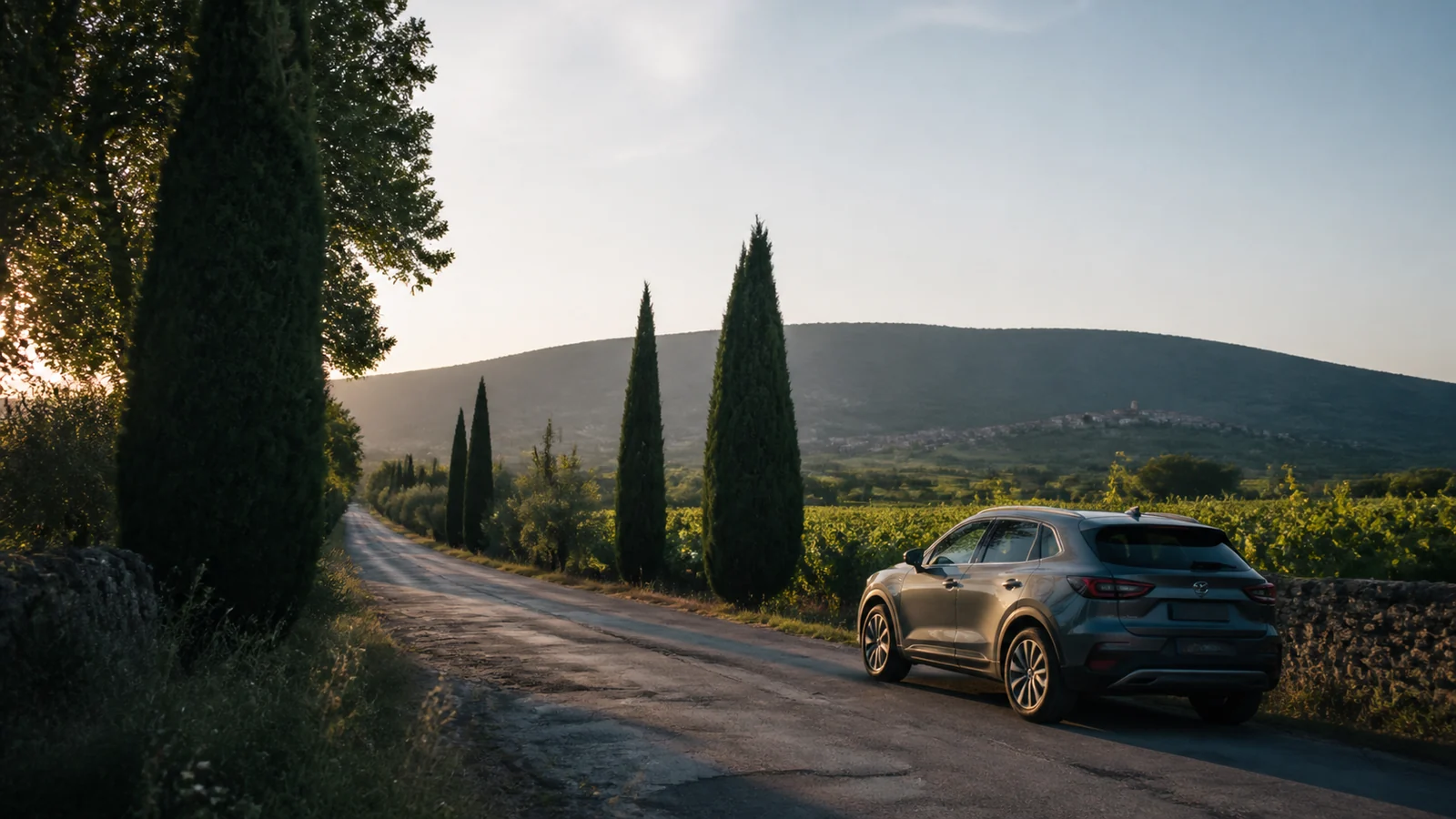
Build a realistic first journey
Le Havre to Etretat
Follow the D940 north for about thirty minutes to reach Etretat, the jewel of the Alabaster Coast. The dramatic cliffs and natural arches are best seen from the coastal path — park at the top of town and walk down to the beach, then climb the paths on either side for different perspectives. The town is compact and gets crowded in summer, so plan to arrive early and allow half a day. The cliffs are spectacular at any time of year, but the light in late afternoon is especially good for photography.
Le Havre to Honfleur
Drive east across the Pont de Normandie, one of the longest cable-stayed bridges in Europe, to reach Honfleur in roughly forty minutes. This port town inspired the Impressionists and remains one of Normandy's most beautiful destinations. The Vieux Bassin, lined with tall narrow houses, is the centrepiece. Park outside the old town and explore on foot — the streets are cobbled and pedestrianised in parts. The seafood restaurants around the harbour are excellent.
Le Havre to the D-Day beaches
Head west on the A29 and D514 for roughly an hour to reach the D-Day landing beaches. Omaha Beach, the American Cemetery at Colleville-sur-Mer, and the remains of the Mulberry Harbour at Arromanches are the key sites. The coastal road is moving and informative, with museums and memorials along the way. This is a full-day trip — start early and take your time. The D514 is a scenic coastal route, slower than the autoroute but far more atmospheric.
Frequently asked questions
Is Le Havre worth visiting, or just a ferry port?
Le Havre is more than a port. The Perret architecture gives it a unique character, and the city has excellent museums, a lively waterfront and some of the best modern art in Normandy. That said, most visitors use it as a gateway to Etretat, Honfleur and the D-Day beaches. A rental car lets you combine the city with the coast in a single trip.
Do I need a car for the D-Day beaches?
A car is highly recommended. The beaches are spread over dozens of kilometres, and public transport between them is limited. With a rental car you can visit Omaha, Utah, Gold, Juno and Sword beaches in a single day, along with the cemeteries and museums. Tour buses run from Le Havre and Bayeux, but they follow fixed routes and timetables. A car gives you the freedom to stop where you want and spend as long as you need at each site.
Is the drive to Etretat difficult?
Not difficult, but it requires attention. The D940 is winding and narrow in places, with drops to the sea on one side. In summer it is busy with tourists and cyclists. The main challenge is parking in Etretat itself. If you are not confident on narrow coastal roads, stick to the main routes and park at the designated lots rather than trying to find street spaces in the village centre.
Can I drive from Le Havre to Paris in a day?
Yes, the A13 autoroute links Le Havre to Paris in roughly two hours without traffic. It is a tolled route but fast and well maintained. Many visitors combine Le Havre with a Paris trip, dropping the car in the capital or returning it to Le Havre before taking the train. Note that driving in central Paris is stressful and parking is expensive, so consider returning the car before you reach the city centre.
Compare Le Havre car hire
Enter dates above, then compare pickup method, vehicle category and complete supplier terms before booking.
Continue planning with Calais car hire, Paris Orly Airport rentals, Le Mans Car Hire, Lyon Airport Car Hire.