

Car Hire UK: Airport & City Pickup Options for Flexible British Travel
The UK packs an extraordinary range of landscapes into a compact space. One day you are navigating London traffic, the next you are winding through the Lake District or tracing the Scottish Highlands. Having a hire car means you are not locked into train schedules or rural bus timetables that run once a day. You can leave when you want, stop where you please, and carry whatever gear the British weather demands. Britain's road network is well-maintained and signposted, though narrow lanes in the countryside and congestion in major cities require a bit of patience. Driving is on the left, roundabouts are everywhere, and manual transmission remains common. For visitors from right-hand-drive countries, allow yourself a short adjustment period before heading onto motorways. Booking through a comparison platform lets you see airport and city-centre options side by side, check what is actually included in the rate, and pick a vehicle suited to your itinerary. Urban runners need something compact. Family trips to Cornwall or the Peak District call for more space. A winter Highlands run may benefit from all-wheel drive. Sorting this out before you arrive saves time and prevents surprises at the collection desk.
A hire car is not just about convenience in the UK. It is about reaching places public transport simply does not serve well. National parks, coastal villages, castle ruins, and remote Scottish glens all become accessible. You can base yourself in one city and day-trip to three others without repacking your suitcase. You can chase the sunset to the coast without checking the last train back. The trade-off is that parking in city centres can be expensive and scarce, and London's congestion charge adds cost if you drive inside the zone. Many travellers choose to collect a car after finishing their urban sightseeing, or drop it off before entering central London. Planning the timing of your rental around your itinerary, rather than defaulting to airport pickup and city return, often saves money and stress. For travellers who value flexibility, a rental car in the UK is the difference between a prescribed route and one you design yourself. Whether you are touring whisky distilleries, hiking the Welsh coast, or chasing literary landmarks through the English countryside, having your own wheels lets you set the pace.
Left-hand traffic; roundabouts replace many intersections
Plan this first.
70 mph on motorways; lower limits apply on single-lane roads and in built-up areas
Confirm before booking.
Valid national licence accepted; International Driving Permit recommended for non-Latin script licences
Confirm before booking.
Petrol and diesel widely available; electric charging network expanding but still patchy in rural areas
Confirm before booking.
Match collection to the actual itinerary
Include transfers, parking days, opening hours and return timing when comparing the two options.
Airport Pickup: Start Your Trip at the Terminal
Collecting a car at a major UK airport is straightforward. Heathrow, Gatwick, Manchester, Edinburgh and Glasgow all have dedicated rental areas or nearby facilities served by shuttle. After a long flight, having the car ready saves you from navigating rail connections with luggage in tow. Airport rates can be competitive because of high volume, though demand spikes during summer and Christmas periods. Booking early locks in vehicle choice and usually secures a better daily rate. Check whether your flight arrival time aligns with the supplier's opening hours, and confirm whether the desk is inside the terminal or requires a short transfer.
City Centre Pickup: Skip the Airport Rush
Not every trip starts at an airport. If you are spending a few days in London, Birmingham or Edinburgh before heading out, collecting downtown avoids the airport premium and lets you skip city traffic on day one. City branches are often near train stations or major hotels, making them convenient if you are already in town. The downside is tighter parking while you collect the vehicle, and some downtown locations have shorter opening hours than airport desks. Weigh the cost saving against the convenience of airport collection, especially if you are travelling with family and bulky luggage.
Plan the handover, price and first drive
James and his partner flew into Manchester for a two-week trip that was supposed to be London and Edinburgh by train. After pricing the rail tickets and factoring in the connections to the Lakes and North Wales, they switched to a hire car. It cost less than the combined train fares and gave them freedom to stay in a farmhouse outside Keswick, hike Helvellyn at dawn, and detour to Llangollen on a whim. What surprised them was how quickly the left-hand driving felt natural. The first hour out of Manchester was tense, especially the roundabouts. By day two they were navigating Lake District lanes with confidence, and by the end of the fortnight they were arguing about whether to move to the Peak District permanently. The car was not perfect. Parking in York cost more than their lunch. The SatNav tried to send them down a farm track near Coniston. But the ability to stop at a village pub because it looked inviting, or pull over for a photograph of a sheep on a drystone wall, made the rental worth every penny. Their advice to future travellers: book the smallest car that fits your luggage, photograph every panel at pickup, and do not try to drive into Edinburgh or Glasgow city centre on a Saturday morning. Otherwise, let the road guide you. Britain is small enough that you can cover serious ground in a fortnight, and varied enough that every hour brings something different.
Check the conditions behind the price
The selected supplier’s terms and booking voucher control the rental. Review them before payment and again before collection.
Total payable price
Compare the full payable amount and inclusions rather than an unsupported daily-price promise.
Deposit and payment card
Confirm the deposit, accepted card type and whose name must appear on the card.
Excess and cover
Read the renter's liability, exclusions and what any optional protection actually changes.
Fuel policy
Know the collection level, return requirement and whether a refuelling charge can apply.
Mileage and territory
Check any distance limit and where the vehicle may be driven.
Extras and return
Price additional drivers, seats, after-hours service and one-way return before payment.
Choose for people, bags and roads
A category normally represents a group of similar cars, not a promise of one exact model.
- Compact: convenient for couples and tighter parking.
- Intermediate: more room for bags and longer journeys.
- Family or SUV category: useful only when the required capacity justifies it.
- Transmission: select automatic explicitly if manual is unsuitable.
Practical planning before departure
Book Early for Popular Periods
Summer holidays, Easter weekends and Christmas travel see UK rental fleets sell out fast. Booking several weeks ahead gives you access to the full vehicle range and usually the available rental options. Last-minute bookings in peak season often leave you with oversized vehicles you do not need or compact cars that will not fit your group.
Understand the Insurance Position
Basic rental rates include statutory cover, but excess liabilities can be high. Check whether your travel insurance or credit card includes rental car excess coverage before paying for additional products at the desk. Photograph the vehicle at pickup and drop-off to protect against disputed damage claims.
Watch for Low Emission Zones
London has the ULEZ and congestion charge. Other cities including Birmingham, Bristol and Glasgow are introducing or expanding clean air zones. If your rental vehicle does not meet the emissions standard, daily charges apply. Ask your supplier whether the car is ULEZ-compliant if you plan to drive into affected areas.
Plan for Narrow Rural Roads
Country lanes in Wales, Cornwall and the Scottish Highlands are often single-track with passing places. A smaller vehicle is easier to manoeuvre than a large SUV. If you are not comfortable with tight spaces or oncoming traffic on narrow roads, stick to A-roads and motorways even if the scenic route looks tempting.
Allow Extra Time for Traffic
Major motorways like the M25, M1 and M6 can grind to a halt during rush hour or after incidents. Check current conditions before setting out, and build buffer time into any schedule that involves airport returns or ferry connections.
Local access, road and operating conditions can change. Check current signs, your supplier instructions and the linked source before travelling: UK official tourism information.
Build a realistic first journey
London to the Cotswolds
Leave the capital via the M40 and A40 for a relaxed run into rolling honey-stone villages. Chipping Campden, Bourton-on-the-Water and Stow-on-the-Wold are classic stops. The roads are good but narrow once you leave the A-roads, so take your time.
Edinburgh to the Scottish Highlands
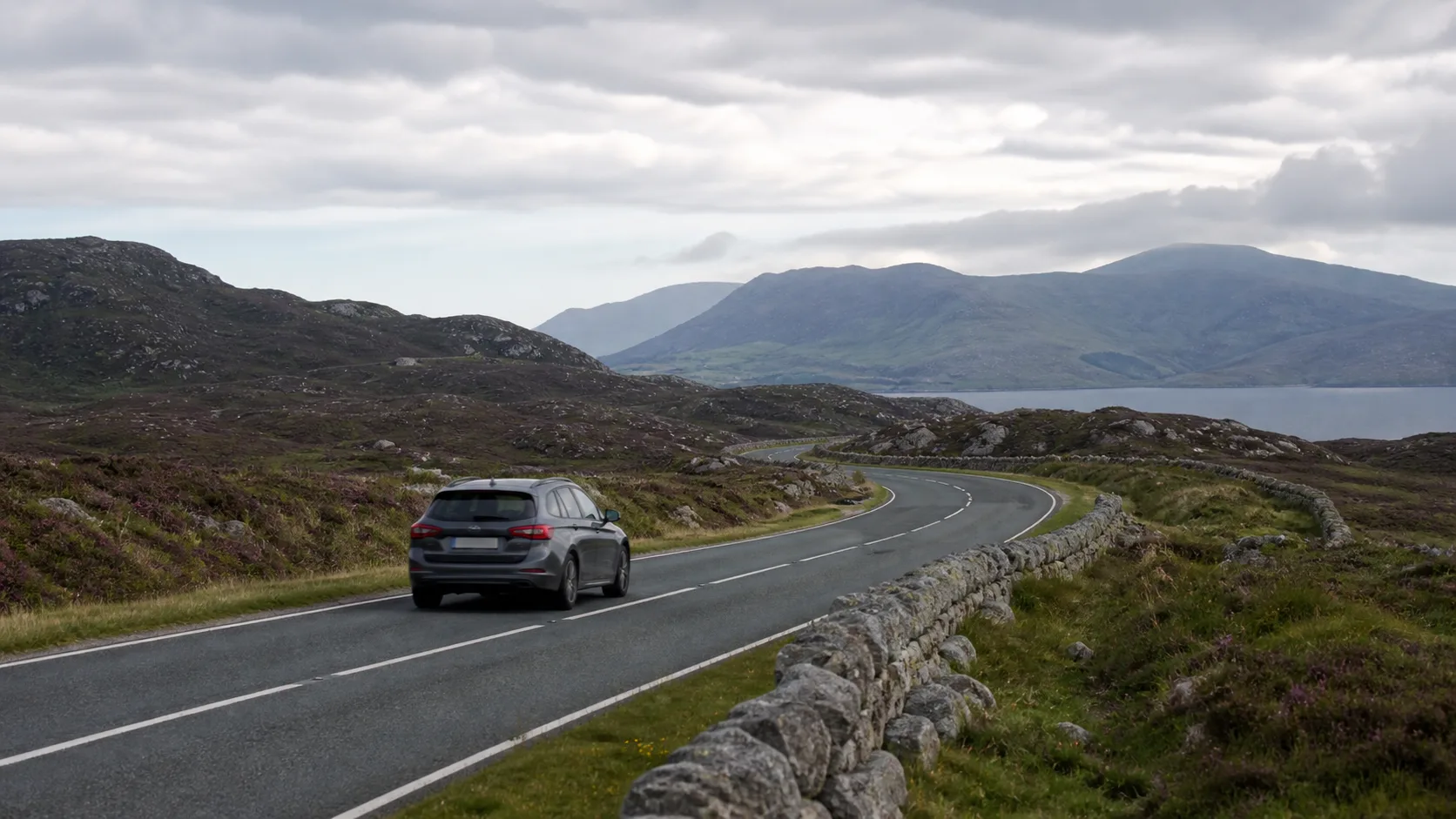
Head north on the A9 through Pitlochry and Aviemore toward Inverness. From there, the A82 along Loch Ness and up to Skye delivers some of Britain's most dramatic scenery. Single-track sections require patience, but the views reward the effort.
Manchester to the Peak District and North Wales
Head east into the Peak District for moorland and gritstone edges, then loop west across Cheshire into Snowdonia. This route mixes accessible driving with serious hiking and outdoor options, all within a few hours of Manchester.
Cardiff to the Pembrokeshire Coast
South Wales to the country's finest coastal National Park. Stop at Tenby and St Davids, then follow the coastal road for cliff-top views and beach access. Summer traffic on the A487 can be heavy, so start early.
Frequently asked questions
Do I need an International Driving Permit for UK car hire?
Most visitors can rent with a valid national licence in English. If your licence uses a non-Latin script or you hold a paper licence rather than a photocard, an International Driving Permit is recommended. Check with your rental supplier when booking to avoid collection-day problems.
Is car hire in the UK expensive?
Rates vary by location, season and how far ahead you book. Airport locations often have the widest choice but can carry premium pricing. City branches may be er but less convenient. Comparing options early is the best way to find a rate that fits your budget.
Can I take a UK rental car to Europe?
Some suppliers allow ferry travel to Ireland or France, but many restrict their vehicles to Great Britain and Northern Ireland only. Cross-border policies vary by company and rate type. Confirm your intended route with the supplier before booking if you plan to leave the UK.
What is the best car for UK road trips?
For city-focused trips, a compact or economy car is easiest to park and fuel-efficient. For rural and family travel, an intermediate estate or SUV offers more luggage space and comfort on longer drives. Consider an automatic if you are not used to manual transmission and left-hand driving.
Are toll roads common in the UK?
Most UK roads are toll-free. The M6 Toll near Birmingham is the main exception, along with some bridges and tunnels including the Dartford Crossing and Severn Bridge. Rental cars are not usually fitted with automatic toll tags, so you may need to pay online after using tolled routes.
Compare UK car hire
Enter dates above, then compare pickup method, vehicle category and complete supplier terms before booking.
Continue planning with UK Car Hire Locations, Inverness Car Hire, Marble Arch Car Hire, Southend-on-Sea Car Hire.