
Renting a Car in Morocco: What European Drivers Need to Know
If you are flying into Casablanca Airport, Marrakech Airport or Tangier Airport and planning to drive, Morocco is one of the most rewarding countries in North Africa to explore by car. The Atlas Mountains, the Atlantic coastline, and the Sahara edge are all within reach. But renting a car as a European driver comes with quirks you will not find in France or Spain. Here is what actually matters.
Do You Need an International Driving Permit?
Yes, technically. Moroccan law requires foreign drivers to carry an International Driving Permit (IDP) alongside their national licence. In practice, many rental desks at major airports will hand over the keys with just an EU photocard licence, especially if you pre-booked online. But if you are stopped at a police checkpoint — and you will be, particularly on the N1 coastal route and near Agadir — not having an IDP can turn a routine document check into an expensive conversation. The permit costs around €15-25 at your local post office or automobile club before you leave. It is cheap insurance against a hassle.
Insurance: What Is Actually Covered
Collision Damage Waiver (CDW) is usually included in the base rate from Moroccan rental desks, but the excess can be steep — often €800-1,500. Theft protection is also standard, but again with a high excess. What catches European drivers out is tyre and windscreen damage. Moroccan roads throw up rocks, and gravel shoulders are common on mountain routes. Many policies exclude these. If you are heading into the High Atlas or Rif Mountains, consider paying the extra €8-12 per day for zero-excess cover, or use a standalone excess reimbursement policy from home.
One more thing: third-party liability is mandatory and included. You do not need to buy extra local liability cover at the desk.
Road Conditions and Driving Style
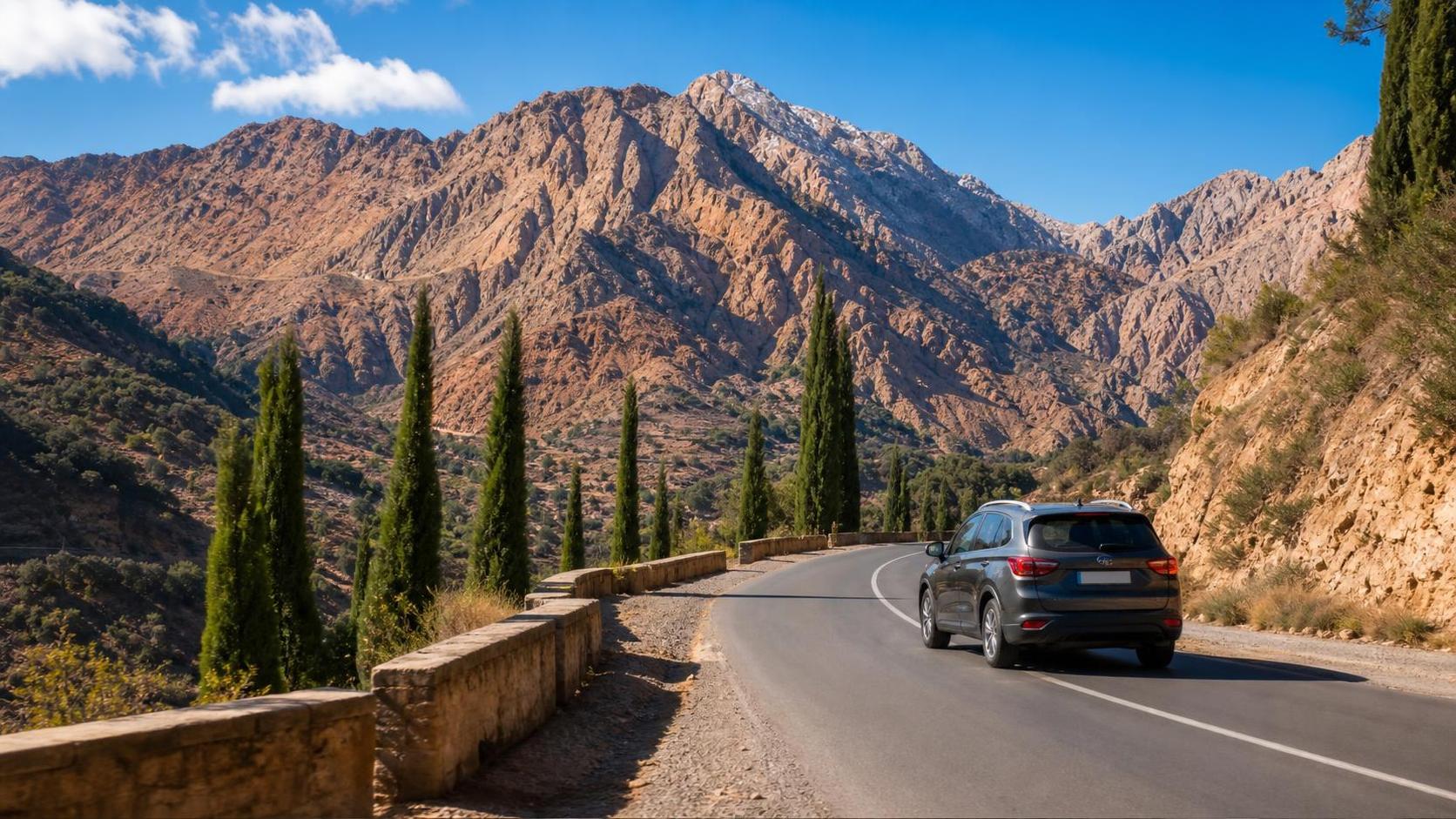
The autoroutes — A1 Casablanca-Rabat, A3 Rabat-Fez, A7 Marrakech-Agadir — are modern, smooth, and tolled. They feel like French motorways. Everything else is variable. The N roads (national routes) range from decent two-lane tarmac to patched surfaces with unmarked speed bumps. The R roads (regional) can be narrow, winding, and occasionally shared with donkeys, mopeds carrying entire families, and lorries that overtake on blind corners.
European drivers often comment that Moroccan traffic feels chaotic. It is not chaotic — it is just different. Roundabouts follow the French system (give way to entering traffic, unless signs say otherwise). Flashing headlights usually mean "I am coming through, do not pull out." Horns are communication, not aggression. You will adapt by day two.
Tolls and Fuel Costs
Autoroute tolls are cash-only at most booths, though some now accept card. Expect to pay roughly:
- Casablanca to Rabat: ~25 MAD (€2.30)
- Casablanca to Marrakech: ~80 MAD (€7.40)
- Rabat to Tangier: ~95 MAD (€8.80)
Keep small notes and coins. The booths do not always give change for 200 MAD notes.
Fuel is subsidised and cheap by European standards — roughly €1.10-1.20 per litre for diesel, slightly more for unleaded. Most stations are full-service; attendants will fill up for you. Tip 5-10 MAD. Carry cash — many rural stations do not accept cards.
Border Crossings from Spain
If you are tempted to take the ferry from Algeciras or Tarifa to Tangier, check your rental contract first. Most Moroccan rental companies do not allow their vehicles to leave Morocco. The few that do — typically international franchises at Casablanca or Marrakech — charge a cross-border fee of €50-150 and require extra insurance. You cannot just drive to Ceuta or Melilla and back without permission. The contract will say so in bold.
If you need a car on both sides, the practical move is to drop the Spanish rental in Algeciras, take the ferry as a foot passenger, and pick up a Moroccan rental in Tangier Med port or Tangier city.
What to Watch For
- Police checkpoints: Common on major roads. Have your licence, IDP, rental contract, and passport ready. Be polite, smile, and you will rarely have an issue.
- Speed limits: 120 km/h on autoroutes, 100 km/h on main roads, 60 km/h in towns. Speed cameras are frequent and fines are paid on the spot.
- Parking: In Marrakech medina and Fes el-Bali, street parking is essentially impossible. Use your hotel or a guarded lot (parking gardé, ~20-40 MAD/day).
- Night driving: Avoid it outside cities. Unlit roads, pedestrians in dark clothing, and stray animals make it genuinely risky.
Is It Worth Renting a Car?
Absolutely, if you are leaving the cities. Morocco’s train network is excellent for Casablanca-Rabat-Fez-Marrakech, but the best parts — the Chefchaouen mountains, the desert near Merzouga, the coastal towns between Essaouira and Agadir — are only practical with a car. A compact hatchback starts around €15-20 per day in low season, rising to €25-35 in July and August. Book early for August.
Compare deals now and find the right vehicle for your Moroccan adventure. Free cancellation and no hidden fees are standard when you book in advance.
Related Destinations
Looking for car hire nearby? Also explore Casablanca Airport car rental, Marrakech Airport car hire, and our full Morocco car hire hub for more locations and pricing.
Ready to book? Visit our homepage for the best hire car deals.